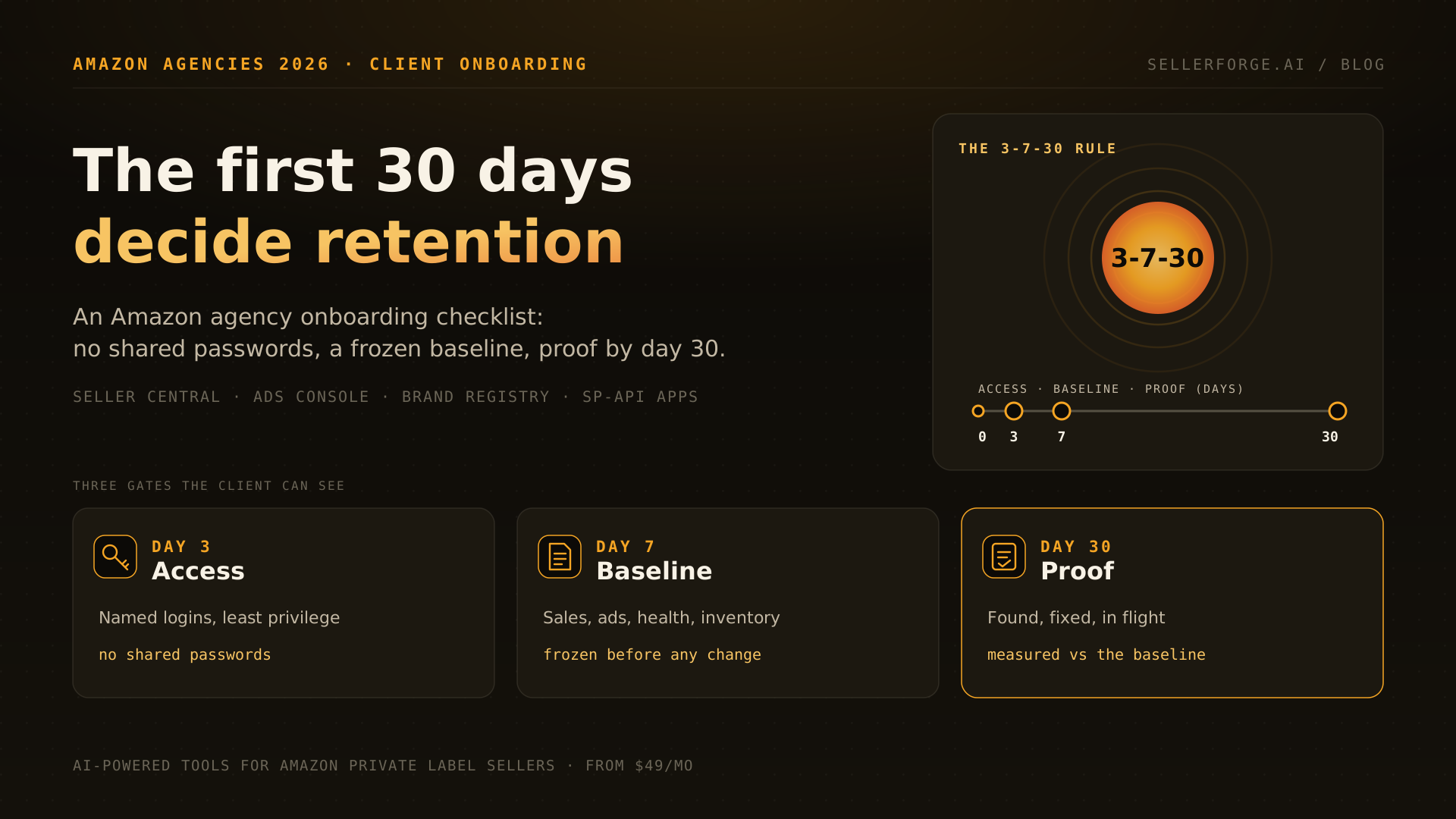
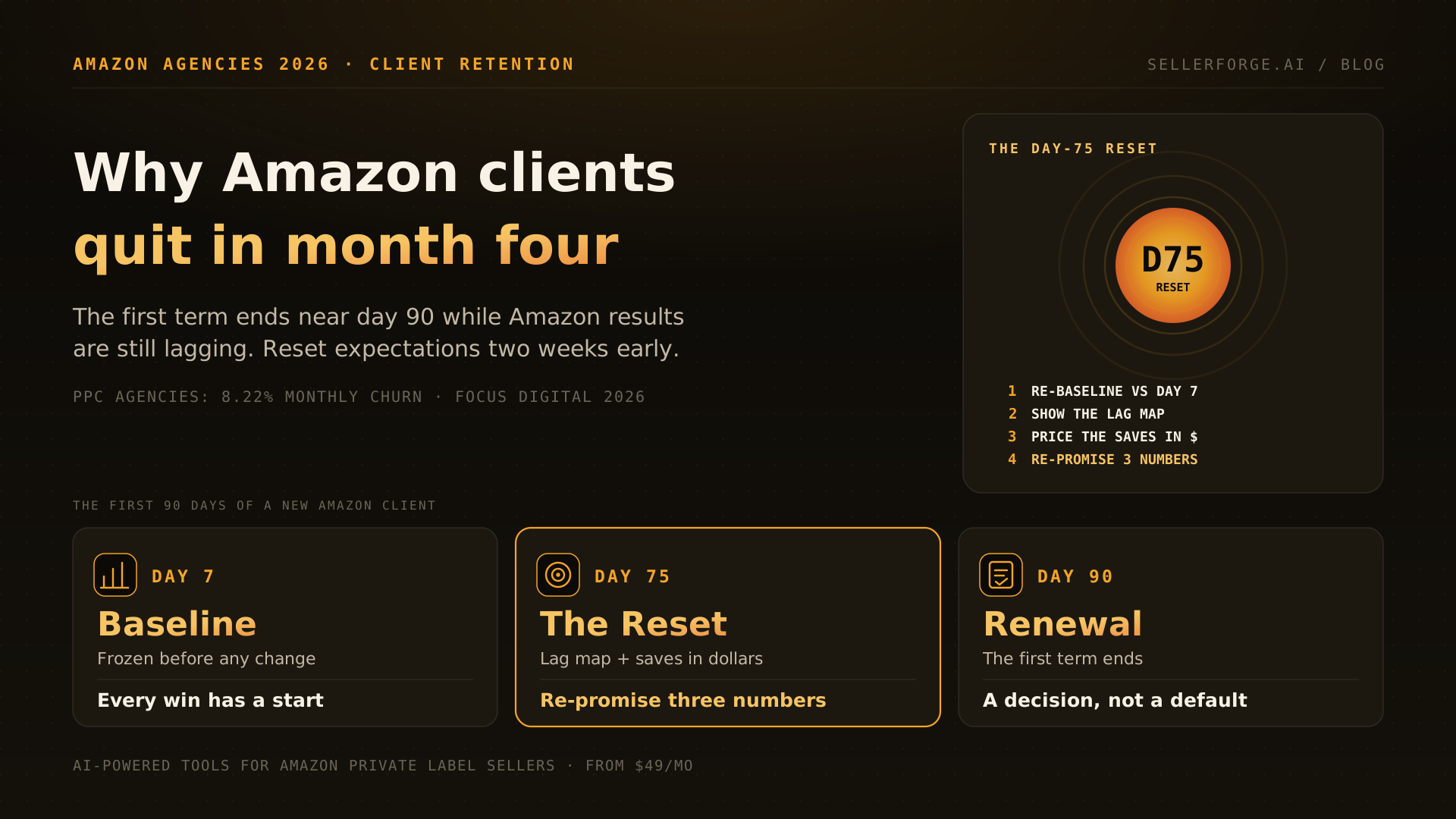
Amazon agency clients most often quit around month four because the first contract term ends near day 90 while most Amazon results (PPC rebuilds, listing changes, inventory fixes) are still lagging, so the client judges unfinished work. Fix it with the Day-75 Reset: re-baseline against day 7, show the lag map, put account-health saves in dollars, and re-promise three numbers. SellerForge (ours, Agency plan $499/mo) logs the change history that proves it.
Amazon agency clients most often quit around month four, and the reason is timing more than performance. The first contract term usually ends near day 90, while the biggest Amazon wins, a rebuilt ad account, rewritten listings, a fixed inventory plan, are still working through Amazon's data lag. The client is asked to judge work that has not finished paying off.
Why Do Amazon Agency Clients Churn in Month Four?
Amazon agency clients churn in month four because three clocks collide. The client's patience clock runs out when the first 90-day term ends. The agency's quick wins are used up by month two. And Amazon's lag clock means the bigger changes are still landing. The client sees a flat third report and an upcoming invoice, and gives notice.
The quick wins are real but finite. In the first 60 days a good agency cuts wasted ad spend, files the reimbursement claims nobody filed, fixes suppressed listings and clears a policy warning or two. Those show up fast. Then the work shifts to things that compound slowly: restructured campaigns that need weeks of clean data, listing rewrites that need weeks of sessions before conversion moves, and inventory fixes that need one full supplier lead time to reach the shelf. Month three is often the quietest month on the dashboard and the busiest month in the account.
In my own agency years, the notice almost never said "results." It said "we want to go a different direction" or "we're bringing this in-house." When I went back through those accounts, the pattern was the same: the client had stopped being able to see what we were doing somewhere in month two or three, and nobody had reset what month four should look like.
What Is a Good Client Retention Rate for an Amazon Agency?
A good annual client retention rate for an Amazon agency is about 75% or better, roughly the retainer benchmark. PPC-only agencies average closer to 36%, which is the bucket many Amazon agencies fall into. The business model you sell predicts churn more than talent does, so pick the row you want to be in before you write the contract.
| Agency model or type | Monthly churn | Annual churn | Avg. client lifespan | Of 100 clients, left after 4 months | Left after 12 months |
|---|---|---|---|---|---|
| Retainer | 2.47% | 25.9% | 40.4 months | ~90 | ~74 |
| Full-service digital | 3.57% | 35.3% | 27.9 months | ~86 | ~65 |
| Hybrid (retainer + performance) | 4.07% | 39.2% | 24.5 months | ~85 | ~61 |
| Performance-based | 4.95% | 45.6% | 20.2 months | ~82 | ~54 |
| Project-based | 6.69% | 56.4% | 14.9 months | ~76 | ~44 |
| SEO specialist | 6.84% | 57.3% | 14.6 months | ~75 | ~43 |
| PPC specialist | 8.22% | 64.3% | 12.1 months | ~71 | ~36 |
The Month-by-Month Churn Map for Amazon Agency Clients
Amazon agency churn risk changes shape every quarter. Month one risk is chaos, months two to four are the expectation cliff, months five to twelve are budget and stakeholder changes, and year two is in-housing. Each stage has a different trigger and a different fix, so a single retention tactic applied all year misses most of them.
| Stage | What the client is thinking | Most common trigger | What prevents it |
|---|---|---|---|
| Month 1 | Did we hire the right people? | A surprise the client found first: a warning, a stockout, a shared-password mess | A tight onboarding with access, a frozen baseline and a day-30 review |
| Month 2 | Where are the results? | Quick wins run out and nobody explained what comes next | Count the quick wins in dollars and publish a lag map |
| Month 3 | Is this worth it? | A flat third report lands next to the third invoice | Book the Day-75 Reset with the decision-maker |
| Month 4 | Renew or walk? | The first term ends and the client defaults to leaving | The reset already happened, with three new numbers agreed |
| Months 5 to 12 | Can we cut this line? | Budget review, new CFO or brand manager, Q4 surprise, January cuts | Quarterly strategy session, stakeholder map, added scope |
| Year 2+ | Could we do this ourselves now? | AI tools and in-house hires absorb execution work | Sell judgment and account protection, not hours |
What Are the Warning Signs a Client Is About to Leave?
The warning signs a client is about to leave are behavioral, and they show up weeks before the notice. Replies slow down, reviews get cancelled or delegated, reports stop getting questions, the client spots a problem before you do, and money or people change on their side. Score them every two weeks and you will see most departures coming.
I turned these into a simple score my account managers could fill in for every client every other Friday. It takes five minutes per account and it is the cheapest early-warning system I know.
| Fade signal | 0 points | 1 point | 2 points |
|---|---|---|---|
| Reply lag | Replies at their normal pace | Replies take about twice as long as in the first 60 days | Questions go unanswered for a week or more |
| Meeting decay | Reviews held with the decision-maker | One review moved or sent to a junior | Two in a row cancelled or delegated |
| Report silence | Reports get questions or replies | One report with no response | Two or more reports with no response |
| Client-first surprises | You flag every material event first | The client found one problem before you | The client found two or more first this quarter |
| Money or people change | No change | New stakeholder on calls, or an invoice paid late | Ad budget cut, scope questioned or a new decision-maker |
- 0 to 2 points: healthy. Keep the cadence.
- 3 to 5 points: fading. Book a reset now with the decision-maker, not the day-to-day contact. Do not wait for the renewal date.
- 6 points or more: at risk. The agency owner joins the next call, and the call is about the client's goals, not your deliverables.
The Day-75 Reset: Hold the Renewal Before It Becomes a Cancellation
The Day-75 Reset is a written review held on day 75 of a new account, about two weeks before a typical 90-day first term ends. It re-baselines results against the day-7 snapshot, shows which wins are still lagging, counts account-health saves in dollars, and re-promises three numbers for the next 90 days. It turns a default exit into a decision.
Day 75 is deliberate. Earlier and there is not enough data to say anything new. Later and the client has already decided, and you are negotiating a notice instead of shaping a renewal. Two weeks also leaves room to fix whatever the review surfaces before the term ends.
- 1Book it at kickoff. Put a 60-minute review on day 75 in the decision-maker's calendar before the kickoff call ends, so it is a standing meeting and not a sales call.
- 2Re-baseline. Compare today's numbers to the baseline you froze on day 7 and sort every metric into three columns: moved, moving, and not yet. Never quote a win without its starting number.
- 3Show the lag map. For each item in the moving column, write the change, the date you made it, and when you expect it to show in sales. In my experience a listing rewrite needs two to four weeks of sessions, a PPC restructure two to four weeks of clean data, and an inventory fix one full supplier lead time.
- 4Count the saves in dollars. List suppressed listings fixed, ASINs reinstated, policy warnings closed and reimbursements recovered. Put a dollar estimate next to each one. Account protection is invisible unless you price it.
- 5Re-promise three numbers. Agree one outcome metric, one leading indicator and one hygiene metric for the next 90 days, plus what the client owes you: inventory, approvals, budget.
- 6Ask the renewal question out loud. "If the term ended today, would you renew? What would have to be true for a yes?" Write the answer down.
- 7Send the one-page summary within 24 hours. The decision-maker forwards it internally, so write it for someone who was not in the room.
The Day-75 Reset in one line: re-baseline, show the lag, price the saves, re-promise three numbers, and ask the renewal question before the client has to answer it alone.
Here is the shape it takes, as a composite of accounts I ran rather than one client's numbers. A home goods brand at day 75 shows flat sales against baseline. The moving column holds a rebuilt ad structure spending less for the same sales, two rewritten hero listings with unit session percentage climbing for three straight weeks, and a reorder that has not landed yet. The saves column holds two reinstated ASINs and a stack of filed reimbursement claims. Same flat topline, completely different conversation. Clients who saw that page at day 75 tended to stay for years.
How Do You Save an Amazon Client Who Has Already Given Notice?
You save an Amazon client who has given notice by changing the conversation from your work to their goal, fast. Ask what would have to be true to stay, offer a defined 30 or 60 day plan with a named owner, and adjust scope or price only if the original scope was wrong. Some clients should leave, and handing over cleanly protects your reputation.
- 1Respond the same day, with the owner or the most senior person on the account, not the account manager who received the notice.
- 2Ask for the real reason and listen. The written reason is usually the polite one.
- 3Separate the fixable from the structural. A missed expectation is fixable. A budget cut, an acquisition or a decision to hire in-house usually is not.
- 4For fixable cases, offer a short written plan: three numbers, 30 or 60 days, a named owner and a check-in date.
- 5For structural cases, offer a smaller scope that fits the new reality, such as account-health monitoring and a monthly review instead of full management.
- 6If they still leave, hand over cleanly: export the baseline and change log, remove your users and apps, and document open cases. Clients who leave well send referrals.
What Keeps Amazon Agency Clients for Years?
What keeps Amazon agency clients for years is visible judgment, not volume of work. Clients stay when the agency catches problems first, explains every change with a before and after, owns more than one part of the account, and has a relationship with more than one person on the client's side. Execution alone is what AI and in-house hires replace first.
- Own more than ads. A client who buys PPC plus listings plus account health has three reasons to renew. AgencyAnalytics finds 56% of clients buy three or more services.
- Map the stakeholders. Know who signs the invoice, who reads the report and who could replace you. Relationships ranked first (80%) among retention drivers in the AgencyAnalytics survey, followed by communication (69%).
- Make every change auditable. Log what changed, when, and what happened at 7, 14 and 30 days. It ends arguments about credit and survives staff turnover on both sides.
- Win the account-health saves loudly. A reinstated ASIN or a closed policy warning is worth more to retention than a month of good ACoS, because the client can picture the loss.
- Re-run the reset every quarter. The Day-75 Reset becomes the quarterly strategy session with the same four parts.
Which Tools Help an Amazon Agency Keep Clients?
No single tool keeps clients, but the right stack makes progress visible. Agencies typically combine a white-label reporting dashboard, a CRM or client-success tracker, a PPC platform and Amazon's own free reports. The gap for Amazon clients is usually account-level context: why a number moved, what changed, and what account-health risk is building.
| Tool type | Retention job it covers | What it misses for Amazon clients |
|---|---|---|
| White-label reporting dashboards (AgencyAnalytics, Swydo) | Branded, scheduled reports across many channels | Mostly ad and traffic data; little on Account Health, inventory or listing changes |
| CRM or client-success tools (HubSpot and similar) | Tracking touchpoints, renewals and churn risk | No Amazon account data, so health scores are based on behavior only |
| PPC platforms (Perpetua, Pacvue, Teikametrics) | Automated bidding and ad reporting | Ads only; the best choice if bidding is the job, but not a whole-account view |
| Amazon's free tools (Business Reports, Account Health dashboard) | Raw sales, traffic and health data | No change log, no client-ready narrative, one account at a time |
| SellerForge (ours, Agency plan $499/mo) | Whole-account view per client: change log with 7/14/30-day deltas, Monday business email, account-health and listing tools | Not an autobidder, not a white-label portal, not a CRM |
Where SellerForge Fits in Agency Client Retention (Disclosure: It Is Ours)
SellerForge fits agencies that want the evidence behind the Day-75 Reset generated per account instead of assembled by hand. Its Agency plan costs $499 a month and includes 10 Amazon seller accounts, with more at $39 a month each up to 40. It is not a PPC autobidder, a white-label client portal or a CRM.
- Pick SellerForge if: you run several Amazon clients and want the change log, weekly summary and account-health tools per account in one workspace, so the day-75 review writes itself.
- Pick something else if: you mainly need automated bidding (Perpetua, Pacvue or Teikametrics are built for that), a branded multi-channel client portal (a white-label dashboard), or renewal tracking across your whole book (a CRM).
If I were running an Amazon agency tomorrow, I would book the day-75 review at kickoff, score the five fade signals every other Friday, and refuse to send any report that quotes a win without its starting number. Clients rarely leave because the work was bad. They leave because, at the moment they had to decide, they could not see it.
About the author
David Gallo is the founder of SellerForge.ai. Before building SellerForge, he managed 57 Amazon seller accounts representing more than $350M in sales at Worldfront, where the clients who stayed longest were the ones who could always see what the agency had found, fixed and was still waiting on.