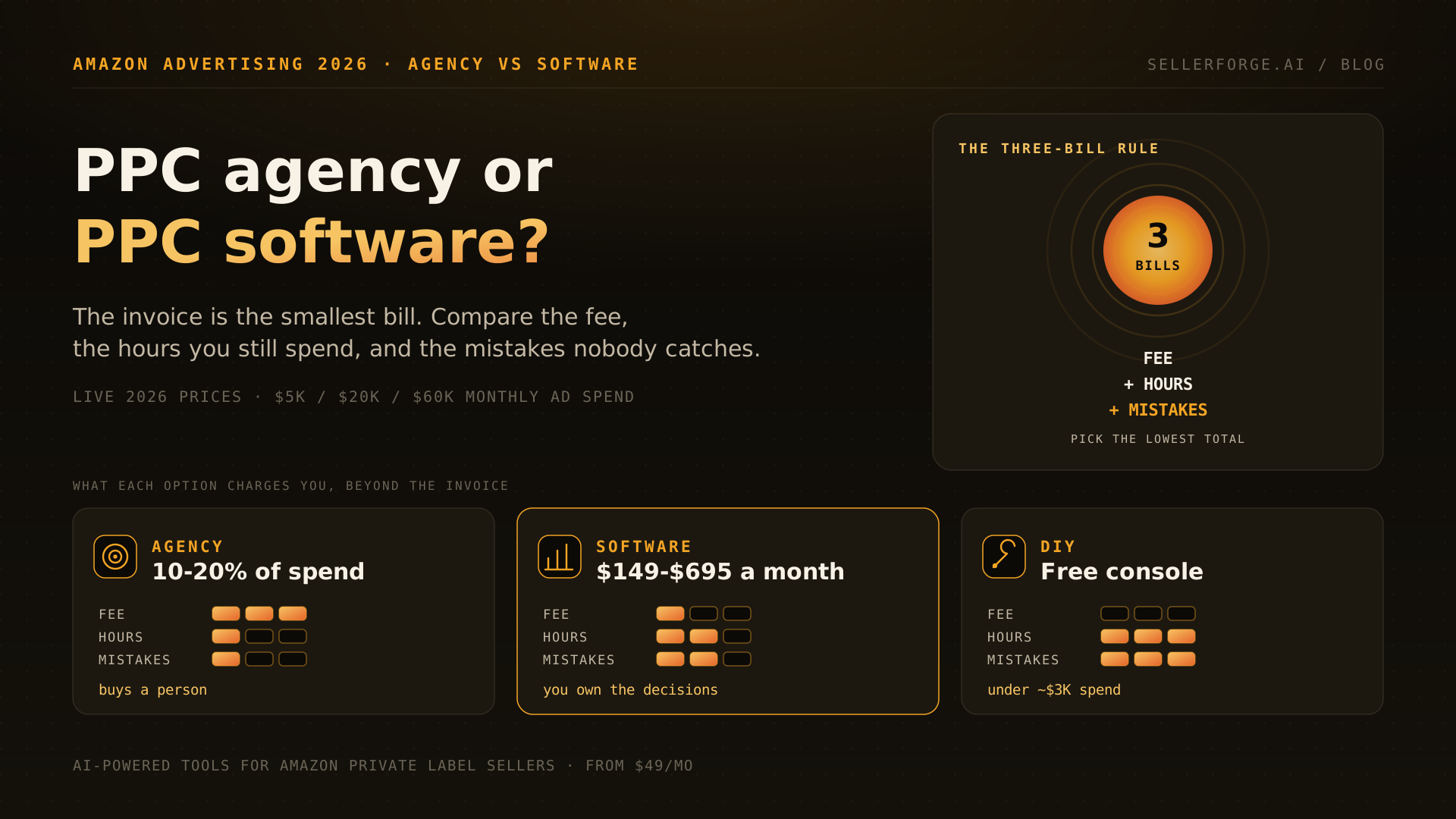
The best Pacvue alternatives in 2026 are Skai for programs spanning four or more retail networks, and Perpetua, Teikametrics, Helium 10 Ads or flat-fee Ad Badger for Amazon-led brands. Skai is the only enterprise option with a published price: $114K a year up to $4M in annual spend. Helium 10 Ads runs Pacvue's own engine for $359/mo plus 2%. SellerForge (ours, from $49/mo) is not a bidder; it reads the account around the ads.
The best Pacvue alternatives in 2026 depend on one number: how many retail networks carry a real share of your ad budget. If the answer is four or more, Skai is the like-for-like enterprise switch, and the only one that publishes a price. If almost all of your spend is on Amazon, you are paying for breadth you do not use, and Perpetua, Teikametrics, Helium 10 Ads or a flat-fee tool such as Ad Badger will run the bidding for far less.
Pacvue itself publishes no prices, so its numbers here are triangulated from 2026 reviews and labelled. That gap matters more than any feature list: the first question in most Pacvue exits is not what the alternative does, it is what Pacvue actually costs you today.
What Are the Best Pacvue Alternatives in 2026?
The best Pacvue alternatives in 2026 are Skai for multi-retailer enterprise programs, Quartile or Intentwise for managed or data-first multi-retailer work, Perpetua and Teikametrics for Amazon-led brands that want AI bidding, Helium 10 Ads for Pacvue's own engine at a seller price, and Ad Badger or Scale Insights for flat-fee control. SellerForge sits beside these, not in place of them.
| Alternative | Price (Nov 11, 2026) | Best for | Where it beats Pacvue | Where Pacvue still wins |
|---|---|---|---|---|
| Skai | $114K/yr up to $4M annual spend; $276K/yr up to $10M (published) | 4+ networks, search and social on one budget | Published, predictable price; 100+ retail networks | Deeper Amazon-native tooling and Pacvue Agent |
| Quartile | No published price; est. $895 to $9,995/mo plus 2 to 5% | Brands that want people plus software | Strategists included; ChatGPT ads partner | Self-serve control for an in-house team |
| Intentwise | No published price; est. from about $500/mo | Data-first teams on Amazon, Walmart, Instacart, Target, Criteo | Data pipelines and an AI gateway over MCP | Breadth beyond its 21 supported marketplaces |
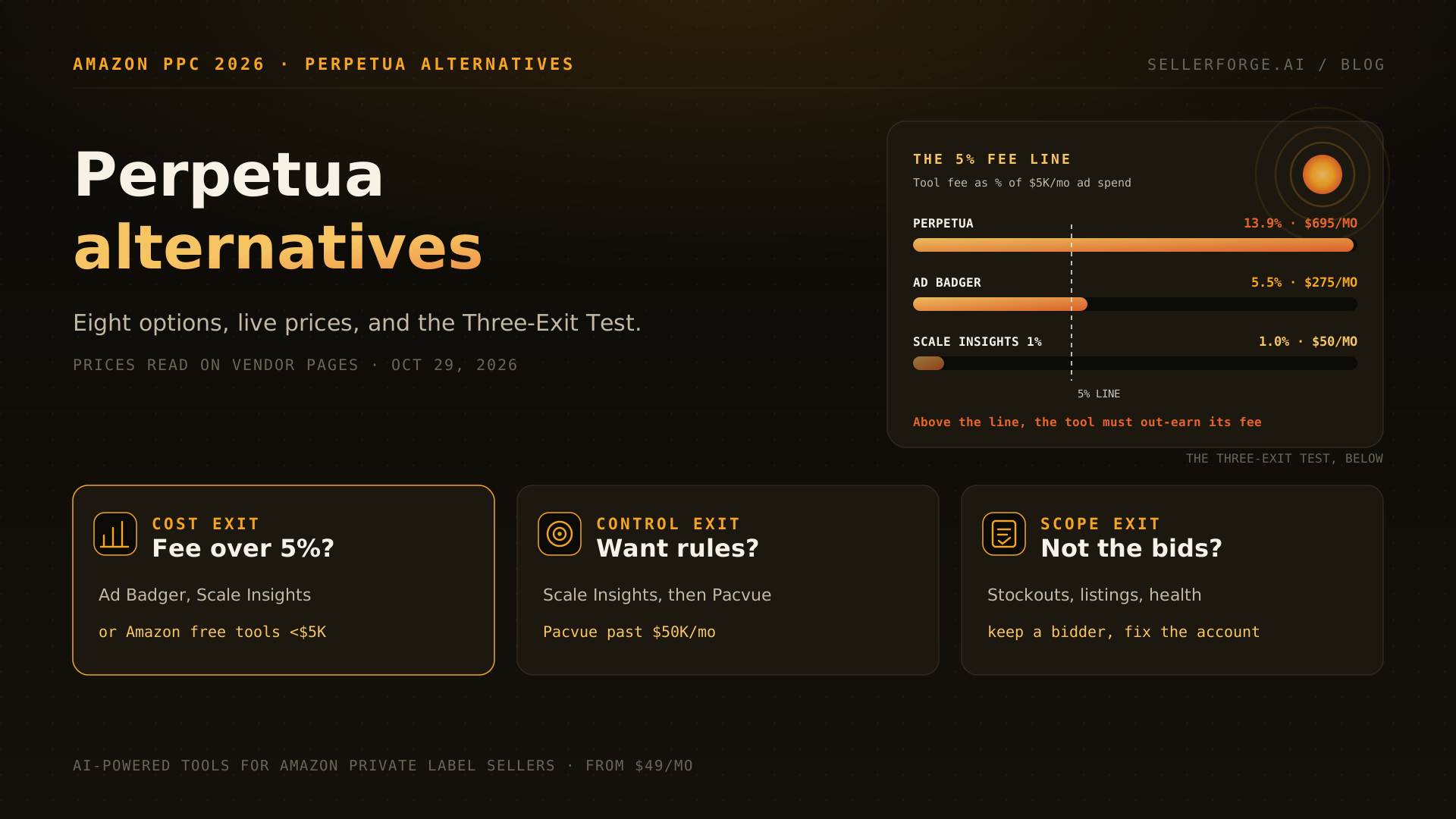
| Perpetua | $695/mo to $10K spend; $695 plus a % above | Amazon-led brands that want goal-based AI bidding | Simpler goals-first workflow, faster setup | Multi-retailer depth and DSP scale |
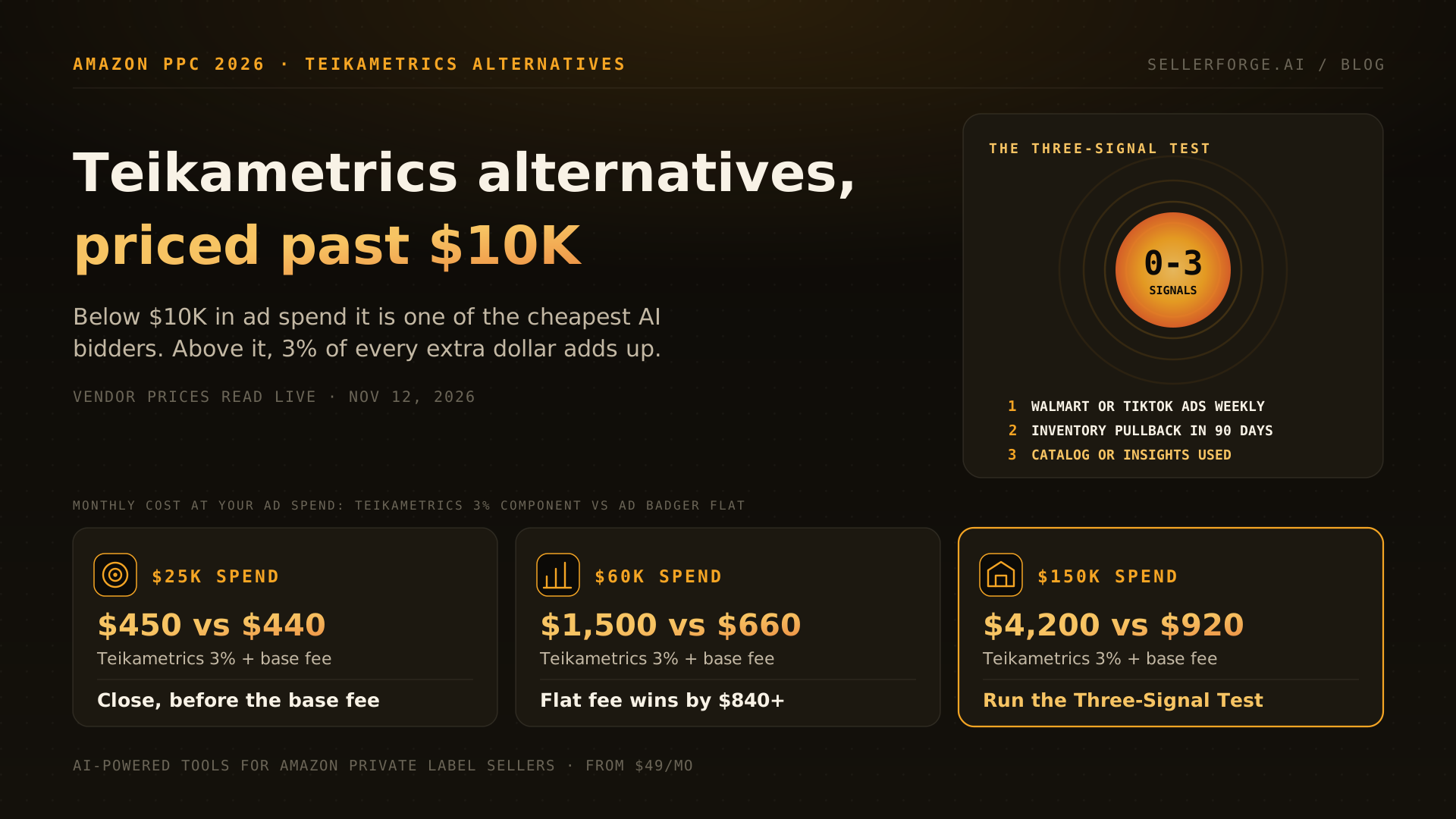
| Teikametrics | $149/mo yearly or $179 monthly to $10K; custom plus 3% above | Amazon plus Walmart or TikTok Shop sellers | Published entry price; inventory-aware bidding | Network count and enterprise reporting |
| Helium 10 Ads | Diamond $359/mo or $279 yearly, plus 2% of managed spend | Amazon sellers who already use Helium 10 | Pacvue's engine at a fraction of the floor | Everything outside Amazon |
| Ad Badger | Flat $275 to $1,830/mo by spend band; 30-day trial | Budget-conscious sellers up to $1.5M/mo | Flat fee that never scales with spend | Automation depth and retail breadth |
| Scale Insights | $78/mo for 5 ASINs up to $688 for 100, or 1% of spend | Hands-on sellers who want rules they write | Cheapest granular control | Hands-off AI and team workflows |
| Amazon Ads console + Ads Agent | $0 extra; conversational agent in closed beta | Under ~$5K/mo or one-person teams | Free, native, first-party data | Cross-retailer anything |
| SellerForge (ours) | From $49/mo; Advertising module on Growth ($99) and up | Sellers and agencies who need the whole account read | Ads read beside inventory, listings, account health | Bidding at scale: SellerForge is not a bidder |
How Much Does Pacvue Cost in 2026?
Pacvue does not publish pricing, so every Pacvue figure is an estimate. 2026 reviews put its fee at roughly 2 to 5% of monthly ad spend, with reported minimums from about $500 a month up to $3,000 to $5,000, and DSP management priced separately. At $80,000 a month in Amazon ad spend, that means roughly $1,600 to $4,000 a month before add-ons.
- Percentage of spend: Ecommerce Times (June 30, 2026) cites agency sources at 2 to 3%; Xneeti's May 2026 review, written by a competitor, says 2 to 5%.
- Minimums: Xneeti estimates about $500 a month; Ecommerce Times reports $3,000 to $5,000. Treat the spread itself as the finding: your floor is negotiated.
- DSP: a separate seat and an Amazon DSP minimum, reported at $10,000 a month in spend.
- Onboarding: a weeks-long setup per Xneeti; six to eight weeks for full implementation per sellers quoted by Ecommerce Times.
When I priced platforms at Worldfront, the line I learned to fear was never the floor. It was the percentage. A 3% fee looks small at signature, then it grows with every dollar of spend you add, including the dollars you add because the platform told you to.
Why Do Brands Leave Pacvue?
Brands leave Pacvue for three reasons: the percentage-of-spend fee outgrows the value of the platform's breadth, the setup and interface take more people-hours than a lean team has, or nearly all of their spend sits on Amazon and a cheaper Amazon specialist does the same bidding. Feature gaps are rarely the reason; Pacvue is one of the deepest tools in the category.
- Cost that scales with success: at 2 to 5% of spend, a brand that doubles its ad budget doubles its platform bill without doubling the work the platform does.
- People-hours: reviewers describe a dense interface with a steep learning curve and rule-based automation that someone has to write and maintain.
- Breadth you do not use: Pacvue's 100+ networks are the product. A brand running 95% of spend on Amazon is paying for 99 networks it never opens.
- A new free floor: Amazon's own Ads Agent conversational experience now diagnoses underperforming campaigns and applies keyword, bid and budget recommendations after you approve them, in closed beta in 25 countries.
The 10% Network Rule: How Many Retailers Do You Really Run?
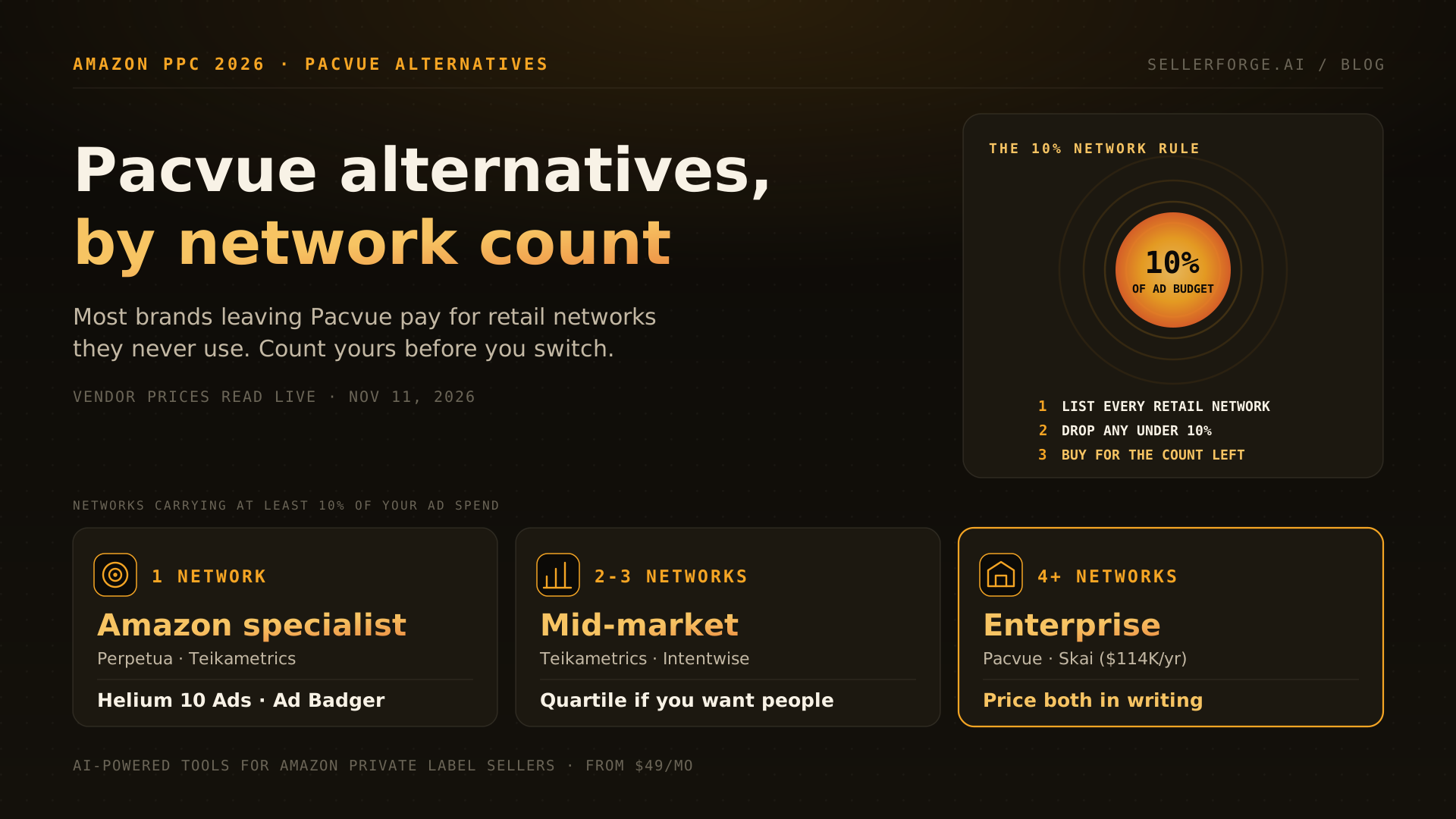
The 10% Network Rule says a retail network only counts toward your platform decision if it carries at least 10% of your total ad budget. Count those networks: one means an Amazon specialist is enough, two or three means a mid-market multi-retailer tool, and four or more is the honest case for an enterprise platform such as Pacvue or Skai.
- 1Pull last quarter's ad spend by retail network: Amazon, Walmart Connect, Instacart, Target Roundel, Criteo and any others, plus Amazon DSP as its own line.
- 2Divide each network's spend by the total. Ignore any network under 10%; it can run in its own native console until it grows.
- 3Count what is left. One network: shortlist Perpetua, Teikametrics, Helium 10 Ads, Ad Badger or Scale Insights.
- 4Two or three networks: shortlist Teikametrics (Amazon, Walmart, TikTok Shop), Intentwise or Quartile, depending on whether you want software or people.
- 5Four or more, or DSP plus search plus social on one budget: stay enterprise. Get Pacvue's percentage and floor in writing and price Skai's published tier against it.
- 6Repeat the count every two quarters. Networks cross the 10% line both ways, and the right platform moves with them.
The 10% Network Rule in one line: you should only pay platform prices for the networks that carry at least a tenth of your budget. Everything below that line can live in a free native console.
Across the accounts I ran, the brands that felt most trapped by enterprise tools were almost always one-network brands that had bought for a multi-network future that never arrived. The rule forces the future to show up in the spend data before you pay for it.
What Would You Pay at $20K, $80K and $300K a Month?
At $20,000 a month, flat-fee and seller tools cost $200 to $760, while Pacvue's reported minimums usually set its bill. At $80,000, Helium 10 Ads and the Pacvue percentage converge near $2,000. At $300,000, Skai's published $9,500 a month is about 3.2% of spend and becomes the predictable enterprise option.
| Tool (monthly cost) | $20K ad spend | $80K ad spend | $300K ad spend |
|---|---|---|---|
| Pacvue (estimate, 2 to 5% plus floors) | $400 to $1,000 by %, but floors of $500 to $5,000 usually set the bill | $1,600 to $4,000 | $6,000 to $15,000 |
| Skai Standard ($114K/yr, published) | $9,500 (47% of spend; use a reseller) | $9,500 (12%) | $9,500 (3.2%) |
| Helium 10 Ads (Diamond $359 + 2%) | $759 | $1,959 | $6,359 |
| Teikametrics (custom base + 3% over $10K) | Base + $300 | Base + $2,100 | Base + $8,700 |
| Perpetua Growth ($695 + undisclosed %) | $695 + % | $695 + % | $695 + % |
| Ad Badger (flat bands) | $440 | $920 | $1,375 |
| Scale Insights (1% plan) | $200 | $800 | $3,000 |
| SellerForge (not a bidder) | $99 Growth | $99 Growth or $199 Pro | $199 Pro or $499 Agency |
Assumptions: Pacvue and Quartile are estimates because neither publishes prices; Perpetua and Teikametrics do not publish the percentage or base above their entry tiers, so those cells show the visible part only; Helium 10 Ads assumes all spend is managed through it; Skai's tiers are annual commitments, reviewable after the first three months according to its pricing page. Quartile is left out of the grid because its estimated range, $895 to $9,995 a month plus 2 to 5%, is too wide to place in one cell.
Pacvue Alternatives Reviewed One by One
Each alternative below is judged on what it does better than Pacvue, what it does worse, and who should pick it. Prices are from the vendor's live pricing page on November 11, 2026 unless marked as an estimate. Vendor-written comparison pages dominate this search, so treat any page that ranks its own tool first, including this one's mention of ours, with that in mind.
Skai: the like-for-like enterprise switch
Skai is the closest replacement for Pacvue's breadth: it lists 100+ retail media and commerce networks, says more than 2,000 brands and agencies use its retail media program, and runs search, social and retail on one plan. Its published tiers are $114K a year up to $4M in annual spend, $276K up to $10M, $504K up to $20M and $756K up to $35M. Where it loses: Pacvue's Amazon-native depth and agent tooling, and Skai only makes sense near the top of its spend bands.
Helium 10 Ads: Pacvue's engine at a seller price
Perpetua: goal-based bidding for Amazon-led brands
Perpetua sets bids from goals you choose rather than rules you write. Essentials is $695 a month up to $10,000 in ad spend; Growth is $695 plus an undisclosed percentage above $10,000; Premium is custom above $500,000. It beats Pacvue on setup time and simplicity for one-network brands and loses on retail breadth and enterprise reporting. Ask for the Growth percentage in writing before you compare it with a Pacvue quote.
Teikametrics: inventory-aware AI with a published entry price
Quartile: software plus strategists
Quartile publishes no prices; third-party 2026 estimates run from $895 to $9,995 a month plus 2 to 5% of spend, with DSP billed separately. It suits brands that want people as well as software across Amazon, Walmart, Google, Instacart and Meta, and it announced a technology partnership for ads in ChatGPT in September 2026. Compare it with an agency retainer, not with a software subscription.
Intentwise: data first
Intentwise leads with data infrastructure (pipelines, a data store and an AI gateway over MCP) and adds ad management for Amazon, Walmart, Instacart, Target Roundel, Criteo and TikTok, across 21 supported marketplaces in total. It says it is built for brands above $10M in revenue and for agencies. It publishes no prices; a RevenueGeeks review updated August 5, 2026 reports ad-platform tiers starting near $500 a month and a 14-day trial.
Ad Badger and Scale Insights: flat-fee control
Amazon Ads console and Ads Agent: the free floor
Where SellerForge Fits (and Where It Doesn't)
SellerForge fits beside whichever bid platform you choose, not in place of it. It is AI account intelligence for Amazon sellers and agencies from $49 a month: it reads ads alongside inventory, listings and account health, so you can see whether a bidding change or the account around it moved results. It is not an autobidder, and if you need algorithmic bidding at scale you should buy one of the tools above.
How Do You Switch Off Pacvue Without Losing a Quarter?
You switch off Pacvue safely by exporting your history and rules first, running the new tool in a monitor or shadow mode for two to four weeks, migrating one campaign group at a time, and only then giving notice. Most of the damage in platform switches comes from lost history and rules nobody remembered writing, not from the new tool's bidding.
- 1Read your contract before anything else: notice period, auto-renewal date and any minimum term. Calendar the notice deadline.
- 2Export everything Pacvue holds that Amazon does not: rule definitions, dayparting schedules, budget pacing settings, custom reports and tags.
- 3Snapshot your baseline: last 90 days of spend, sales, ACoS and TACoS by campaign group, so the new tool is judged against a fixed number.
- 4Connect the alternative in monitor or shadow mode and let it learn for two to four weeks while Pacvue keeps bidding.
- 5Migrate one campaign group at a time, starting with the smallest, and turn the matching Pacvue rules off the same day so two tools never bid on one campaign.
- 6Hold the old rules and exports for one full season after cancelling, because the first Q4 on a new platform is when a forgotten rule matters.
The Operator's Bottom Line
Pacvue is a strong platform for the problem it was built for: many retail networks, big budgets and a team that lives in the tool. Most brands searching for a Pacvue alternative do not have that problem. Count your networks with the 10% Network Rule, then buy for the count you have, not the one you hope for.
- Four or more networks above 10%: stay enterprise. Price Skai's published tier against Pacvue's written quote and negotiate.
- Two or three networks: Teikametrics for software you steer, Quartile for people plus software, Intentwise for a data-first team.
- One network, $10K to $300K a month: Perpetua for goal-based AI, Helium 10 Ads if you already run Helium 10, Ad Badger for a flat fee.
- One network under $10K a month: Scale Insights, Teikametrics Essentials or Amazon's free console.
- Whatever bidder you choose: SellerForge (ours) to read the ads beside inventory, listings and account health.
About the author
David Gallo is the founder of SellerForge.ai. Before building SellerForge, he managed 57 Amazon seller accounts representing more than $350M in sales at Worldfront, where his teams priced, ran and replaced most of the ad platforms in this article on live accounts. He writes about Amazon operations, advertising and AI from the operator's side.