Pay for Amazon PPC software when your ad spend is under about $30,000 a month and someone on your team can give it four to eight hours a week; pay an agency when nobody has that time, you need creative or DSP work, or spend is high enough that judgment is worth 10-20% of it. Use the Three-Bill Rule: fee + hours + mistakes. SellerForge (ours, from $49/mo) is an AI ad analyst, not an autobidder.
Pay for Amazon PPC software if your ad spend is under roughly $30,000 a month and someone on your team can give advertising four to eight focused hours a week. Pay an agency if nobody has those hours, if you need creative or DSP work along with search ads, or if your spend is large enough that a senior strategist's judgment is worth 10-20% of it. Most sellers in between do best with a hybrid.
Amazon PPC Agency vs Software: Which Should You Pay For?
Choose software when you have the hours and want to own the decisions; choose an agency when you lack the hours or need skills beyond bidding. Software is cheaper on the invoice at almost every spend level, but it still needs a person. An agency costs more but buys that person, plus creative and strategy, if it is a good one.
| Question | Points to software | Points to an agency |
|---|---|---|
| Monthly ad spend | Under about $30,000 | Over about $30,000, or rising fast |
| Hours someone can give PPC each week | Four to eight, reliably | Under two, or nobody owns it |
| What is broken | Execution: bids, negatives, budgets, harvesting | Strategy, structure, creative, or nobody knows |
| Ad types in play | Sponsored Products, Brands, Display | Plus DSP, video, multiple marketplaces |
| How you want to work | You approve changes and keep the account knowledge | You want reports and outcomes, not the work |
| Contract tolerance | Monthly, cancel anytime | Three to six month terms with notice |
If most of your answers sit in one column, you have your answer. If they split, read the Three-Bill Rule section below before signing anything, because the invoice is the smallest part of the decision more often than people expect.
How Much Does an Amazon PPC Agency Cost in 2026?
An Amazon PPC agency typically costs 10-20% of monthly ad spend, or a flat $1,500-$5,000 a month, with many agencies setting monthly minimums of $1,000-$2,500. Contracts usually run three to six months with 30-90 days' notice. At $20,000 a month in ads, that is roughly $2,000-$4,000 a month in management fees.
| Pricing model | Typical 2026 range | What it rewards | Watch for |
|---|---|---|---|
| Percentage of ad spend | 10-20% of monthly spend | Spending more | Fee grows when you scale, whether or not results do |
| Flat retainer | $1,500-$5,000 a month | Predictability | Scope creep, and a junior manager carrying too many accounts |
| Minimum fee | $1,000-$2,500 a month floor | The agency's time | At $5,000 in spend, the floor is 20-50% of your budget |
| Hybrid or performance | Base fee plus bonus on ROAS or growth | The metric in the bonus | A bonus on revenue pays for spend, not profit |
The hidden part of the agency bill is the account manager's load. When I priced our own retainers, the honest unit was hours per account per week, and a manager carrying 12 or more accounts cannot give each one more than a few hours. Ask how many accounts your manager carries before you compare fees.
How Much Does Amazon PPC Software Cost in 2026?
Amazon PPC software costs between $0 and about $900 a month for most sellers, and enterprise platforms quote custom pricing. Flat-fee tools charge by ad-spend band; others add a percentage of spend above a threshold. Every price below was read from the vendor's live pricing page on November 3, 2026, except where noted.
| Option | Live 2026 price | Spend band | Best for |
|---|---|---|---|
| Amazon Ads console | Free | Any | Rule-based bids and budget rules under about $3,000 a month |
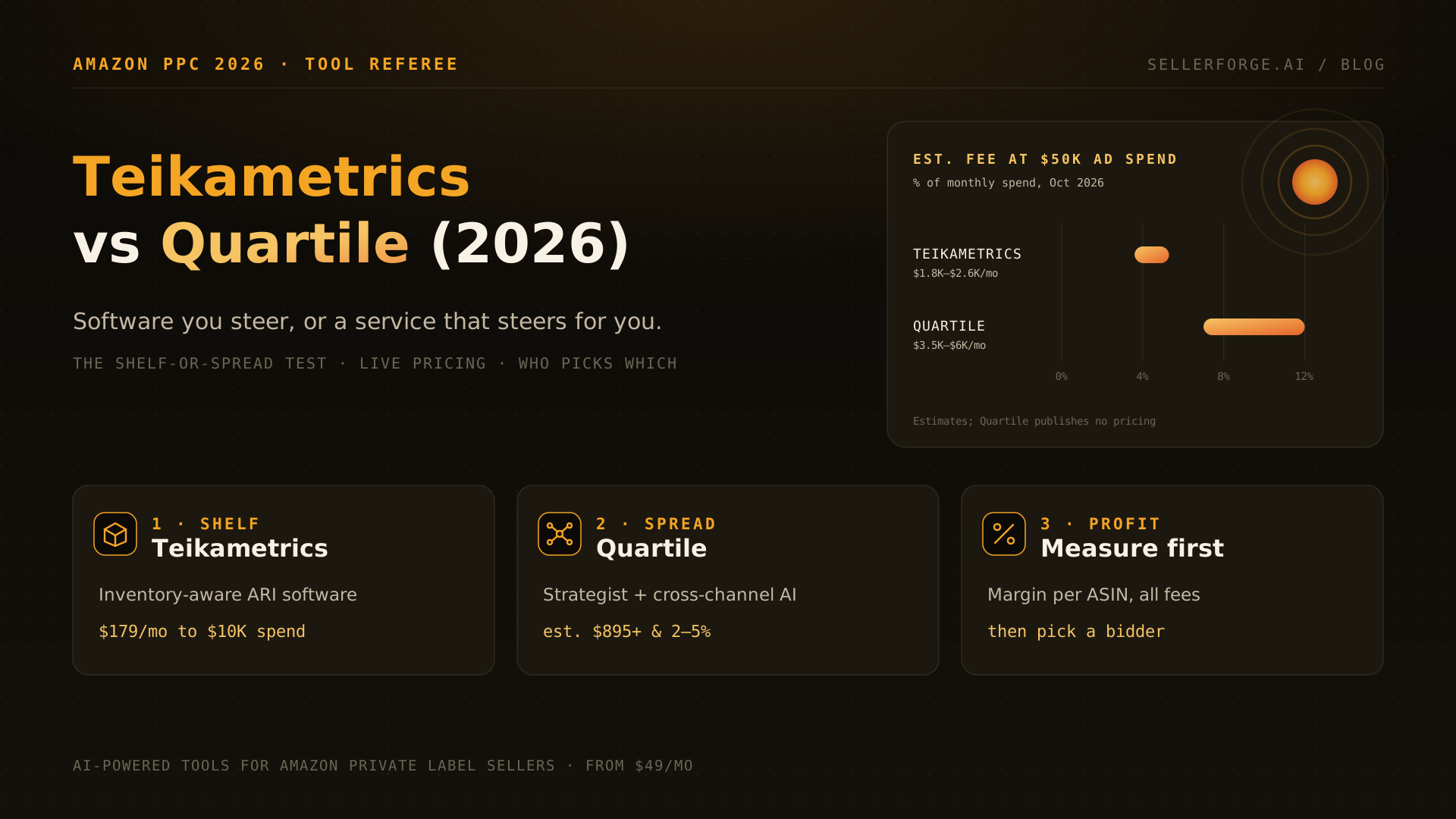
| Teikametrics Essentials | $149/mo billed annually, $179 monthly | Up to $10,000; Advanced adds 3% of spend over $10,000 | Inventory-aware AI bidding for smaller catalogs |
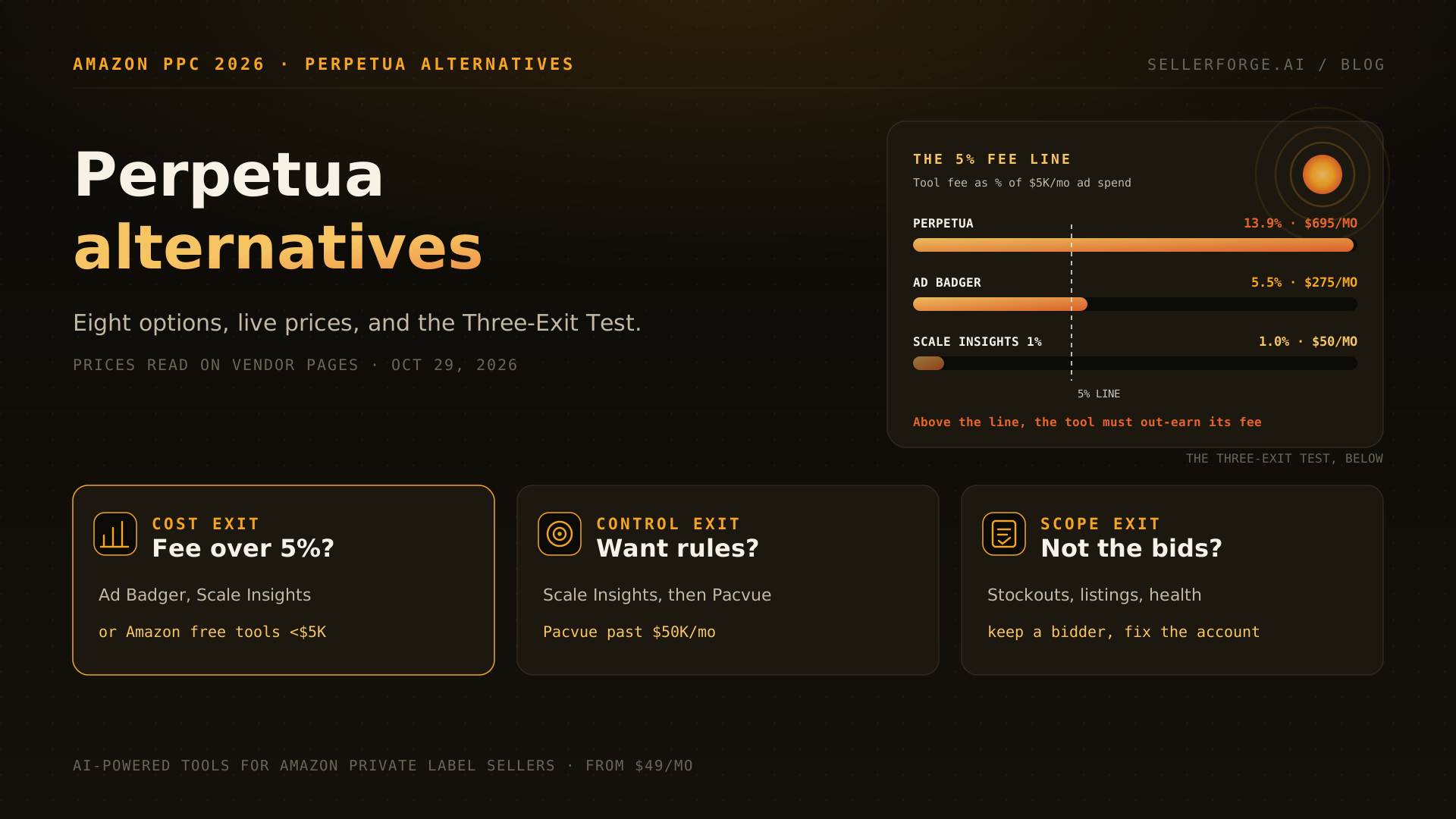
| Ad Badger | $275 / $440 / $660 a month | Up to $5,000 / $25,000 / $75,000 | Flat fees that do not punish scaling; 30-day trial |
| Helium 10 Ads | Diamond plan $359/mo ($279 yearly) plus 2% of managed spend | Diamond accounts only (read Oct 28) | Sellers already paying for Helium 10 Diamond |
| Perpetua | $695/mo up to $10,000; Growth adds a percentage above | $10,000+ spend | Goal-based automation across larger accounts |
| Pacvue | Custom quote | Enterprise | Multi-retailer, DSP and AMC at high spend |
| SellerForge (ours) | Advertising module from Growth $99/mo; plans from $49 | Any | AI diagnosis of the whole ad account, with changes you approve |
Two patterns matter more than any single price. First, percentage fees hide in almost every tier above $10,000 in spend, so do the math at your number, not at the headline. Second, the cheapest tools are cheap because they assume you will make the decisions they cannot.
The Three-Bill Rule: Fee, Hours and Mistakes
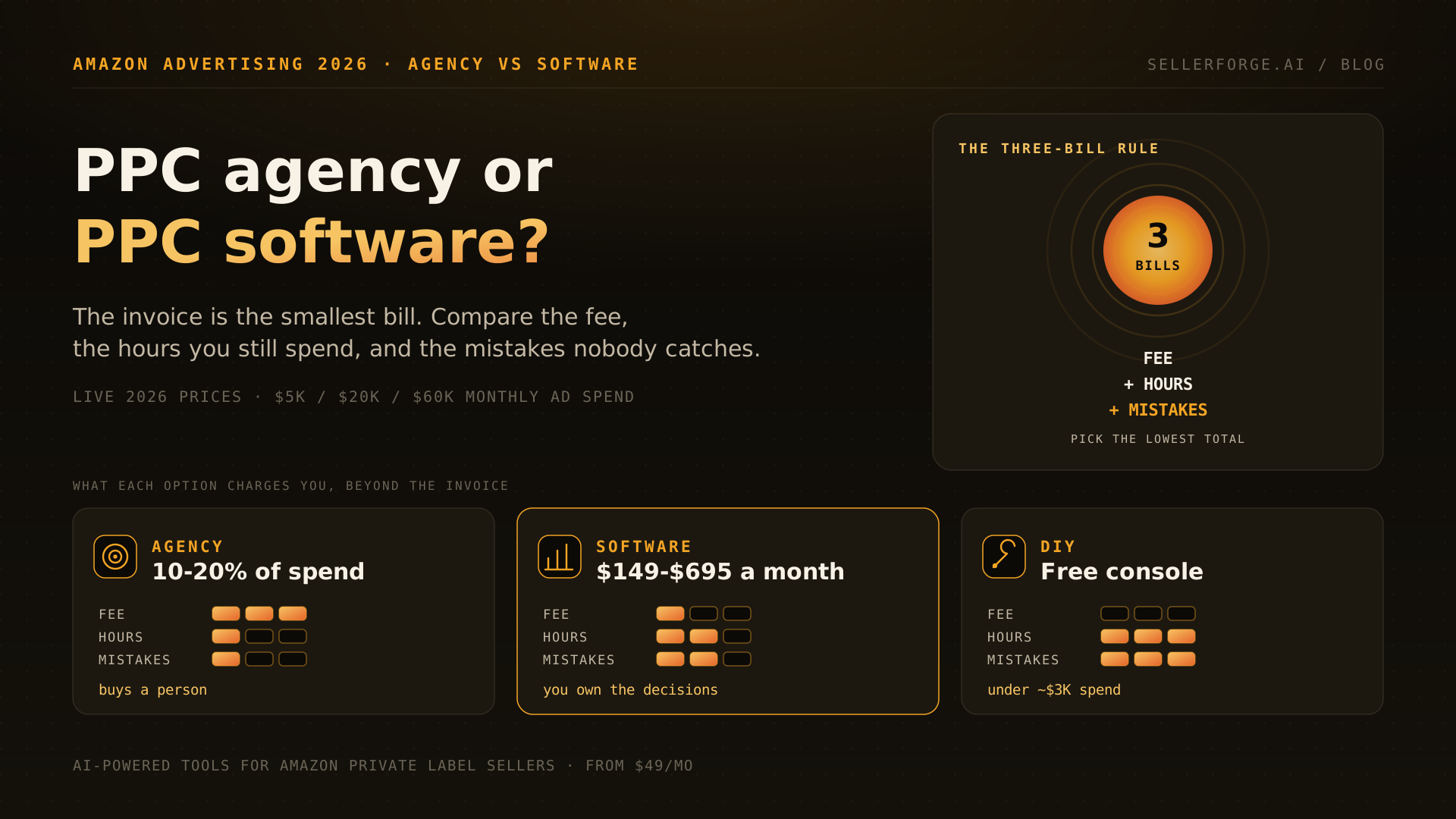
The Three-Bill Rule says every Amazon PPC option charges three bills: the fee on the invoice, the hours your team still spends, and the mistakes bill from decisions nobody made or made badly. Agencies charge a high fee and few hours. Software charges a low fee and some hours. DIY charges no fee and many hours. Pick the lowest total.
The fee bill is easy to compare, which is why it dominates most decisions. The hours bill is the one software vendors leave out: someone still has to set targets, read search terms, approve changes and notice when a product goes out of stock. The mistakes bill is the one agencies sell against, and it is real: a negative keyword never added, a budget that ran dry at 2 p.m. on a Saturday, a campaign still bidding on a discontinued ASIN.
Here is the rule worked through at three spend levels. My assumptions, stated so you can swap in your own: agency at 15% of spend with a $1,500 monthly floor; software at Ad Badger's live band price; your time valued at $60 an hour; two hours a week reviewing an agency, two to eight hours running software, and five to fifteen hours doing it all yourself.
| Monthly ad spend | Agency: fee + your review time | Software: fee + your hours | DIY in the console: your hours | Lowest fee + hours |
|---|---|---|---|---|
| $5,000 | $1,500 + $520 = $2,020 | $275 + $520 (2 h/wk) = $795 | $0 + $1,299 (5 h/wk) = $1,299 | Software |
| $20,000 | $3,000 + $520 = $3,520 | $440 + $1,039 (4 h/wk) = $1,479 | $0 + $2,598 (10 h/wk) = $2,598 | Software, if you have the 4 hours |
| $60,000 | $9,000 + $520 = $9,520 | $660 + $2,078 (8 h/wk) = $2,738 | $0 + $3,897 (15 h/wk), rarely realistic | Software on paper; the mistakes bill decides |
On fee plus hours alone, software wins at every level, and that is the trap. The third bill is what changes the answer. At $60,000 a month, a 5% efficiency gain is worth $3,000 a month, still less than the $6,782 fee-plus-hours gap in this example; the agency would need to prevent larger losses or provide other value to justify its premium. At $5,000, the same 5% is $250, which no agency floor can beat.
The Three-Bill Rule in one line: an agency is worth its fee when the mistakes it prevents are worth more than the fee minus the hours it saves you. Below about $10,000 a month in spend that is almost never true. Above about $50,000 it often is, unless you have a capable person in-house.
What Does an Agency Do Each Week That Software Doesn't?
Each week, a good Amazon PPC agency makes judgment calls software cannot: restructuring campaigns, choosing which products deserve budget, briefing creative, planning launches and deals, and explaining results. Software handles the repetitive execution: bids, negatives, harvesting, budgets and dayparting. Whoever owns the judgment is the real choice you are making.
| Weekly job | Agency | Software | You still own it? |
|---|---|---|---|
| Bid changes and dayparting | Yes, often through its own software | Yes, continuously | No |
| Search-term harvesting and negatives | Yes | Yes, with rules or AI suggestions | Approval, with software |
| Campaign structure and naming | Yes | Partly; most tools assume a structure you set | With software, yes |
| Which products get budget | Yes, if it knows your margins | Only if you feed it costs and targets | Always, ultimately |
| Launch, deal and seasonal planning | Yes | No | With software, yes |
| Sponsored Brands video and creative | Often included or billed extra | No | With software, yes |
| DSP and Amazon Marketing Cloud | Larger agencies, yes | Enterprise platforms only | Rarely at small scale |
| Weekly report and explanation | Yes | Dashboards; you write the story | With software, yes |
A detail many sellers miss: most agencies run their own bidding software underneath. You are often paying for the same class of tool plus a person deciding how to use it. That is a fair trade when the person is good. It is a bad one when the person is a junior manager applying a template to a dozen accounts.
When Is an Amazon PPC Agency Worth It?
An Amazon PPC agency is worth it when advertising has no owner on your team, when you need creative or DSP beyond search ads, when you spend enough that small efficiency gains outweigh the fee, or when you are entering a new marketplace. In those cases the fee buys capacity and skill you cannot get from a tool.
- Nobody owns advertising: the founder is the PPC manager on Sunday nights. A good agency is cheaper than the mistakes bill of a part-time owner.
- You need more than search ads: Sponsored Brands video, DSP, retail media on other retailers, or Amazon Marketing Cloud analysis.
- Spend is high and growing: above roughly $50,000 a month, a strategist who finds a few points of efficiency covers the fee.
- You are launching in a new marketplace or a large new line, and want people who have done it many times.
- You want accountability: a named team, a weekly call and a contract, rather than a dashboard nobody opens.
Agencies also lose clients faster than most sellers realize, which is a reason to choose carefully rather than a reason to avoid them.
What About the Hybrid Model?
The hybrid model pairs PPC software with part-time human judgment: a freelance consultant or a fractional strategist for a few hours a month, or an agency on a narrow scope such as DSP or creative only. For sellers spending roughly $10,000-$50,000 a month, it usually beats both pure options on the three bills together.
- 1Run day-to-day execution in software you control: bids, negatives, harvesting and budgets.
- 2Keep one person on your team as the owner, with two to four protected hours a week to approve changes and watch stock.
- 3Buy judgment by the hour or the project: a monthly structure review, a launch plan, a quarterly audit.
- 4Give any outside expert read access to your tools rather than the keys to your account.
- 5Re-run the Three-Bill Rule each quarter; when spend doubles, the answer can change.
How Do You Switch Between an Agency and Software?
Switch between an agency and software on a planned date with your data exported first: campaign settings, search-term history, negatives and the agency's change log. Revoke old access the day the new owner starts. Expect two to four weeks of noise while bids settle, and do not judge the new setup before a full month of comparable data.
- 1Export everything: bulk campaign files, 60-90 days of search-term reports, negative keyword lists and any rules or schedules.
- 2Ask the outgoing agency for its change log and any creative files you paid for. Check your contract's notice period first.
- 3Freeze a dated baseline of spend, sales, ACoS and TACoS so the next month has something honest to be compared with.
- 4Connect the new tool or agency, then remove the old one's users and app authorizations so two owners never edit the same campaigns.
- 5Change one thing at a time for the first two weeks, and log every change.
Where SellerForge Fits (Disclosure: It Is Ours)
SellerForge fits sellers and agencies who want the analyst's job done in software: a written diagnosis of the whole ad account, search-term recommendations and changes you approve, alongside listing, inventory and account-health context. It is not a 24/7 autobidder, a creative studio or a DSP desk. For those jobs, the tools and agencies above win.
- Pick SellerForge if: you want to own PPC decisions with an AI analyst doing the diagnosis, or you run an agency that wants the analysis layer for every client in one workspace.
- Pick an autobidder if: you want bids moving continuously toward a target with little review (Perpetua, Teikametrics, Ad Badger or Scale Insights fit different budgets).
- Pick an agency if: nobody on your team will own advertising, or you need creative, DSP or new-marketplace expertise.
If I were deciding today for a brand spending $20,000 a month with a capable operations person, I would run software, give that person four protected hours a week, and buy an outside review once a quarter. If the same brand had nobody to own the account, I would hire a small agency and ask exactly how many accounts its manager carries.
About the author
David Gallo is the founder of SellerForge.ai. Before building SellerForge, he managed 57 Amazon seller accounts representing more than $350M in sales at Worldfront, where he priced agency retainers by the hour and watched which ad budgets earned them. He writes about Amazon advertising, operations and tools from the operator's side.