Amazon takes 26% to 41% of the sale price in referral and FBA fees on its 2026 rate cards, and 38% to 54% all-in once storage, placement and a typical 10% ad spend are added. Cheap items lose the biggest share because FBA fees are flat dollars. The often-quoted 50% comes from Marketplace Pulse's 2023 study of seller accounts. SellerForge (ours, from $49/mo) helps on the leak side: fee-overcharge reimbursements and inventory forecasting.
Amazon takes 26% to 41% of the sale price in referral and FBA fulfillment fees on a typical FBA product in 2026, and 38% to 54% all-in once storage, inbound placement and a 10% ad budget are added. Those numbers come from Amazon's own 2026 rate cards, worked through four real price points below, not from a survey.
The other number you will see everywhere, "Amazon takes 50%," is also real, but it is Marketplace Pulse's February 2023 analysis of seller profit-and-loss statements, built on 2022 fee levels. It is a good average and a poor planning tool. In this post I rebuild the take rate from the fee schedule so you can see which line moves for your products. One disclosure: SellerForge is our product, from $49 a month, and I will say exactly where it helps and where a different tool is the better buy.
Across the 57 Amazon accounts I managed at Worldfront, more than $350M in sales, the sellers who got hurt by fees were rarely the ones paying the highest rate. They were the ones who never split the bill into the part Amazon sets, the part their own operations set, and the part they chose to spend.
What percentage does Amazon take from sellers?
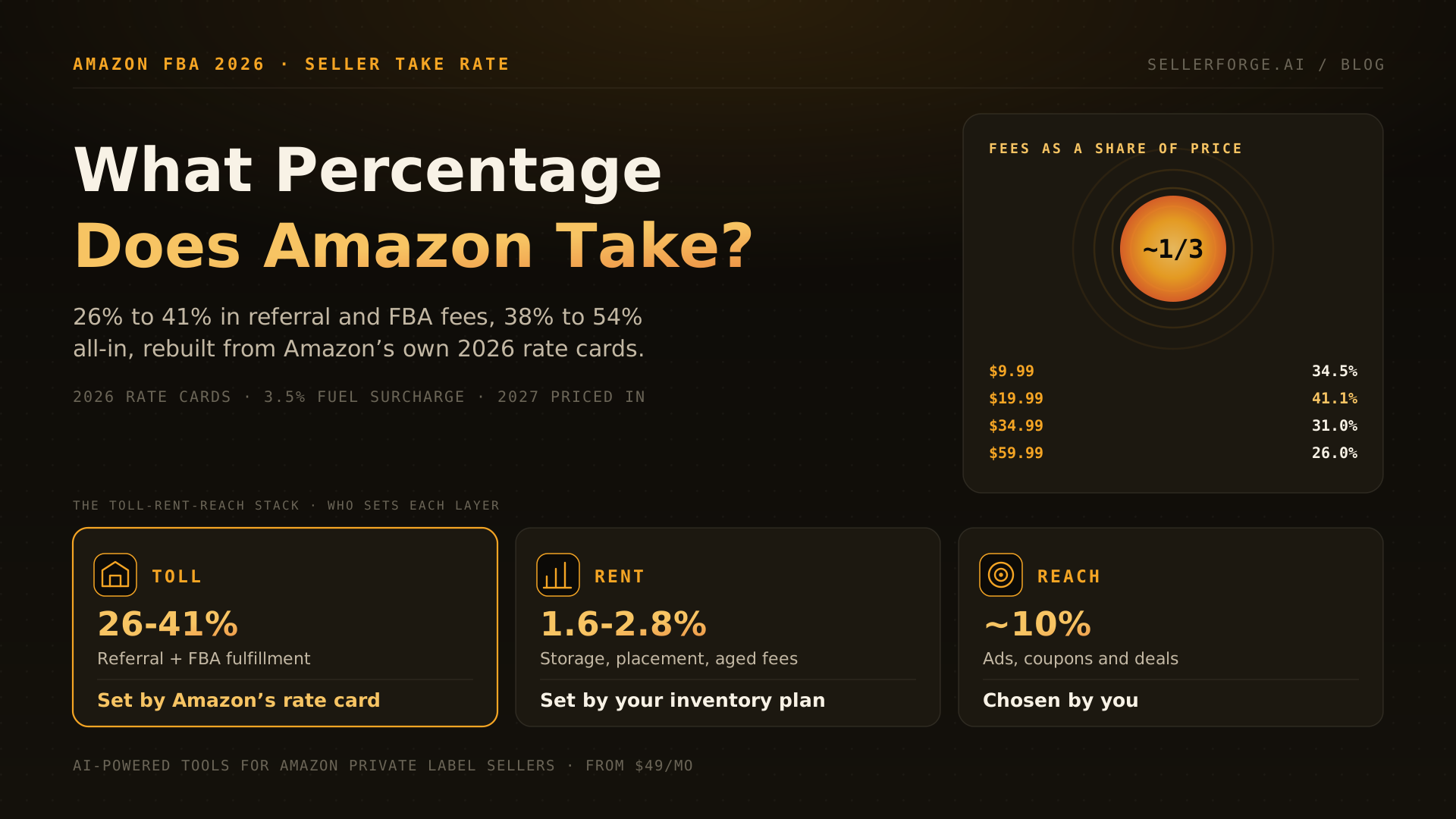
Amazon's take rate is the share of each sale that goes back to Amazon as fees and advertising. For FBA products in 2026 it runs about 26% to 41% in referral and fulfillment fees alone, rising to roughly 38% to 54% once storage, placement and a 10% ad spend are included. The lower the price, the higher the share, because fulfillment fees are flat dollar amounts.
| Price point (2026, non-peak) | Referral + FBA fee | Share of price | All-in with storage, placement, 10% ads |
|---|---|---|---|
| $9.99 beauty item, small standard 4 to 6 oz | $3.45 | 34.5% | 47.3% |
| $19.99 kitchen tool, large standard 1 to 1.25 lb | $8.22 | 41.1% | 53.9% |
| $34.99 home item, large standard 1.25 to 1.5 lb | $10.86 | 31.0% | 42.9% |
| $59.99 home item, large standard 2.25 to 2.5 lb | $15.58 | 26.0% | 37.6% |
Every fulfillment fee in that table is Amazon's 2026 non-peak rate multiplied by 1.035 for the 3.5% fuel and logistics surcharge that started on April 17, 2026. The referral fee follows Amazon's published referral rates: 8% for the beauty item (Beauty pays 8% at $10 or under) and 15% for the home and kitchen items. The storage, placement and ad assumptions are in the worked section below, so you can swap in your own.
Rule of thumb: on a typical FBA product, Amazon's fees take roughly a third of the price and advertising takes another tenth. A product whose landed cost is 30% of the price keeps roughly 16% to 32% before overhead.
What fees make up Amazon's take rate? The Toll-Rent-Reach Stack
Amazon's take rate is made of three layers that behave differently. The Toll is the referral and fulfillment fee charged on every unit sold. The Rent is what your inventory choices cost: storage, inbound placement, low-inventory and return fees. The Reach is advertising and promotions, which you choose. I call it the Toll-Rent-Reach Stack, and each layer needs a different fix.
- Toll (set by Amazon, per unit sold): the referral fee, 15% in most categories with a $0.30 minimum, plus the FBA fulfillment fee by size tier, weight and price band, plus the 3.5% fuel surcharge. You change it only through price, packaging, size tier or fulfillment method.
- Rent (set by your operations): monthly storage at $0.78 per cubic foot for standard-size items from January to September and $2.40 from October to December, inbound placement fees on minimal shipment splits, the low-inventory-level fee when supply drops under 28 days, aged inventory surcharges, and return-related fees. Good planning shrinks it.
- Reach (chosen by you): Sponsored Products, Sponsored Brands, coupons, deals and Prime-exclusive discounts. It is the layer with the widest range, from under 5% of sales for a reseller to well over 15% for a launch.
- Fixed overhead: the Professional selling plan costs $39.99 a month, or $0.99 per item sold on the Individual plan, per Amazon's pricing page. At 500 units a month the Professional plan adds about $0.08 a unit, which is too small to change the take rate.
The reason to split it this way is practical. When a seller tells me Amazon takes too much, the first question is which layer. A high Toll is a pricing and packaging problem. A high Rent is an inventory problem. A high Reach is an advertising problem. Each has a different owner and a different fix, and lumping them into one percentage hides all three.
How much does Amazon take per sale at $10, $20, $35 and $60?
Amazon takes about $3.45 on a $9.99 item, $8.22 on a $19.99 item, $10.86 on a $34.99 item and $15.58 on a $59.99 item in referral and fulfillment fees, using 2026 non-peak rates with the fuel surcharge. Storage and placement add another $0.28 to $0.96 per unit under the assumptions below, and advertising adds whatever your total ad spend ratio is.
| Line (per unit) | $9.99 small standard | $19.99 large standard | $34.99 large standard | $59.99 large standard |
|---|---|---|---|---|
| Referral fee | $0.80 (8%) | $3.00 (15%) | $5.25 (15%) | $9.00 (15%) |
| FBA fee + 3.5% surcharge | $2.65 | $5.22 | $5.61 | $6.58 |
| Toll subtotal | $3.45 (34.5%) | $8.22 (41.1%) | $10.86 (31.0%) | $15.58 (26.0%) |
| Storage, ~2 months at a $1.19 blended rate | $0.04 | $0.16 | $0.22 | $0.40 |
| Inbound placement, minimal split (mid-range) | $0.23 | $0.37 | $0.37 | $0.47 |
| Refund admin fee at a 5% return rate | $0.01 | $0.03 | $0.05 | $0.09 |
| Rent subtotal | $0.28 (2.8%) | $0.56 (2.8%) | $0.64 (1.8%) | $0.96 (1.6%) |
| Reach at a 10% ad spend ratio | $1.00 | $2.00 | $3.50 | $6.00 |
| All-in take rate | 47.3% | 53.9% | 42.9% | 37.6% |
The assumptions, so you can replace them: package sizes of 7 x 5 x 0.75 in, 10 x 4 x 3 in, 9 x 6 x 3 in and 12 x 8 x 3 in, all inside their weight bands after dimensional weight; units sitting in a fulfillment center for about two months at a blended storage rate of roughly $1.19 per cubic foot (nine off-peak months at $0.78 and three peak months at $2.40); placement at the midpoint of Amazon's 2026 minimal-split range for each band; and Amazon's refund administration fee, which keeps the lesser of $5.00 or 20% of the referral fee on each refund.
What this leaves out is just as important. Returns processing fees apply only to products whose return rate is above their category threshold. The low-inventory-level fee applies only when both 30-day and 90-day days of supply fall below 28. Aged inventory surcharges start after 181 days. Any of these can add several points for a specific ASIN, which is why the account average is the wrong place to look for problems.
To run your own ASINs through the same math, our free FBA fee calculator carries every 2026 band, the peak card and the surcharge. The Reach line is where most of the variation lives; our Amazon PPC benchmarks by category show what a normal ad spend ratio looks like in your category, and the TACoS and break-even ACoS guide shows how to set a ceiling per product.
Does Amazon really take 50% of sales?
For many private-label sellers, yes, once advertising is counted. Marketplace Pulse's 2023 study of seller profit-and-loss statements found a typical seller paid a 15% referral fee, 20% to 35% in FBA fees including storage, and up to 15% in advertising, more than 50% in total and up from about 40% five years earlier. Fees alone, without ads, are usually well under 50%.
The study is still the most-cited number on the subject, and in a follow-up the same publication said a typical private-label seller paid 50% to 60% of sales in fees during 2023. Two things make it hard to plan with. It is an average across sellers, so it blends different price points, sizes and ad strategies. And it predates the 2024 inbound placement and low-inventory fees, the January 2026 fulfillment changes and the 3.5% surcharge. My rate-card rebuild above lands in the same range, 38% to 54% all-in, so the headline still holds as an average. Your own number can sit well above or below it.
Amazon's own results point the same way. In the third quarter of 2026 Amazon reported $46.49 billion in third-party seller services revenue, up 9%, and $19.64 billion in advertising revenue, while third-party sellers accounted for 61% of paid units, as reported by PPC Land from Amazon's release. Seller fees and ad spend are two of Amazon's largest revenue lines, and both keep growing.
Why do cheaper products lose a bigger share to Amazon?
Cheaper products lose a bigger share because the FBA fulfillment fee is a fixed dollar amount set by size and weight, while the price shrinks. A $5.22 fulfillment fee is 26% of a $19.99 item but under 9% of a $59.99 one. Low-Price FBA rates for items under $10 soften this, but a $9.99 item still gives up about a third of its price.
- The $10 line helps: items under $10 get Low-Price FBA rates, about $0.77 to $1.01 lower than the $10 to $50 rate in 2026. Pricing at $10.49 instead of $9.99 can cost you more in fees than the extra 50 cents brings in.
- The $50 line hurts more in 2027: standard-size items above $50 already pay $0.26 more than the $10 to $50 rate. From January 15, 2027 that gap widens to about $0.55 to $0.57, so a large standard item at $50.99 pays roughly $0.59 more to fulfill than the same item at $49.99.
- Size tier beats price: moving a product from large standard to small standard, or keeping it under a weight band, often saves more than any price test. A half-inch of packaging can change the tier.
- Bundles raise the price per order and spread one fulfillment fee over more value, which is why multipacks lower the take rate on low-price consumables.
The $19.99 item in my table is the worst case on purpose. It is above the Low-Price FBA line but still large standard, so it pays a full $5.04 base fulfillment fee on a price that leaves little room. I saw this shape constantly: kitchen and home tools priced at $19.99 because competitors were, losing 41% to fees before a single ad click. The fix was usually packaging or a two-pack, not a price cut.
What changes in Amazon fees in 2027?
Amazon announced on November 5, 2026 that FBA fulfillment fees will rise by an average of $0.19 per unit from January 15, 2027, about 0.8% of the average selling price, according to Amazon's 2027 US fee update. The 3.5% fuel surcharge stays. From February 1, 2027 the storage utilization surcharge ends and aged inventory moves into a single age-based storage rate.
| Example product | 2026 Toll | 2027 Toll (from Jan 15) | Change |
|---|---|---|---|
| $9.99 small standard 4 to 6 oz | 34.5% | 37.0% | +2.5 pts (fulfillment $2.56 to $2.80) |
| $19.99 large standard 1 to 1.25 lb | 41.1% | 41.9% | +0.8 pts ($5.04 to $5.19) |
| $34.99 large standard 1.25 to 1.5 lb | 31.0% | 31.5% | +0.5 pts ($5.42 to $5.57) |
| $59.99 large standard 2.25 to 2.5 lb | 26.0% | 26.8% | +0.8 pts ($6.36 to $6.83) |
The per-band 2027 rates above are from PPC Land's breakdown of the 2027 rate card, which matches the published tables; check your own SKUs in Amazon's Fee Change Comparison dashboard before January 15. Three details matter more than the average. Small standard items under $10 rise more than most, which pushes cheap consumables up the take-rate curve. Five fee categories, including Automotive, Computers and Media, lose Low-Price FBA rates and pay the $10 to $50 rate. And the storage change cuts costs for inventory that turns in under six months while raising them for aged stock, which our aged inventory surcharge guide walks through. The 2026 line-by-line changes are in our 2026 FBA fee changes and DD+7 guide.
How do you calculate your own Amazon take rate?
You calculate your Amazon take rate by adding every fee and ad dollar Amazon charged over a period and dividing by product sales for the same period. Do it for the whole account and for each ASIN, and split the result into Toll, Rent and Reach so you know which layer to work on.
- 1Pick a full month that is not October to December, or run both a peak and an off-peak month, because storage and fulfillment change in Q4.
- 2From Seller Central payments reports, total product sales, referral fees, FBA fulfillment fees and the fuel surcharge. That is your Toll.
- 3Add storage, aged inventory surcharge, inbound placement, low-inventory-level, returns processing and refund administration fees. That is your Rent.
- 4From the advertising console, add Sponsored Products, Brands and Display spend, plus coupon and deal fees. That is your Reach.
- 5Divide each layer, and the total, by product sales. Then repeat per ASIN and sort by the highest total.
- 6Check the top five ASINs against the rate cards. A Toll above about 35% points to price band or size tier, a Rent above about 5% to inventory planning, and a Reach above your category's normal ad spend ratio to advertising.
The step most sellers skip is the last one: checking that Amazon charged the right fee. Wrong size-tier measurements and fee overcharges are a known source of leakage, and the recovery window is limited. Our Amazon fee leakage audit covers how to spot them, and Amazon FBA profit margin benchmarks by category show what should be left after the take rate and your product cost.
Where SellerForge fits (and where it does not)
SellerForge is our product, so weigh this section with that in mind. It does not change what Amazon charges and it is not a per-order profit tracker. It helps on two parts of the take rate that sellers lose quietly: fees Amazon overcharged that can be reclaimed, and the Rent layer that bad inventory timing creates. For everything else, Amazon's free tools come first.
| Option | Cost | What it does for your take rate | Where it falls short |
|---|---|---|---|
| Amazon Revenue Calculator | Free | Estimates referral and FBA fees for any ASIN before you list or reprice | One product at a time; no storage history or ads |
| Fee Change Comparison dashboard (Amazon Profit Analytics) | Free | Shows how the January 15, 2027 changes hit your own SKUs | Fee changes only; not a monthly take-rate view |
| Payments and advertising reports in Seller Central | Free | The raw numbers for the six-step calculation above | Manual export and spreadsheet work every month |
| Dedicated profit trackers | Paid, varies by tool | Per-order fee and margin dashboards | Do not file reimbursement cases or plan inventory for you |
| SellerForge (ours) | From $49/mo | Core ($49): nightly scans for 8 reimbursement categories, including fee overcharges, with case text you review and submit. Growth ($99): forecasting with reorder points and out-of-stock risk, plus the Weekly Business Report | Not a profit tracker; does not lower Amazon's rate card; you submit claims yourself |
Where it helps in practice: Reimbursement Claims scans your reports nightly for lost inbound units, damaged inventory, returns never received and fee overcharges, tracks each category's claim window, and prepares the case text so you keep 100% of the recovery instead of paying an agency 20% to 25%. Forecasting sets reorder points from velocity, seasonality and lead time, which is how you stay above the 28-day low-inventory line without paying for aged stock. The Weekly Business Report puts the week's changes in one place.
Where it does not: if you want a per-order net margin dashboard, a dedicated profit tracker is the better tool, and our comparison of profit tracking software covers them. If your only question is what one ASIN will cost to fulfill, Amazon's free Revenue Calculator answers it.
The bottom line
Amazon takes about a third of the price in fees on a typical FBA product and close to half once advertising is counted, with cheaper and bulkier items paying the highest share. The 50% headline is a fair average but a poor plan. Split your own number into Toll, Rent and Reach, check it per ASIN, and fix the layer that is out of line: price and packaging for the Toll, inventory timing for the Rent, ad targets for the Reach.
If you want reimbursement recovery and inventory forecasting working on the parts of the take rate you can control, start a free SellerForge trial. Plans start at $49 a month.
About the author
David Gallo is the founder of SellerForge.AI. Before building it, he managed 57 Amazon seller accounts representing more than $350M in sales at Worldfront, where the monthly fee review split every account's Amazon bill into what Amazon set, what operations caused and what the team chose to spend. He writes the SellerForge blog for operators who would rather read the rate card than the rumor.