Keepa is worth it if you make at least one decision a week about an Amazon listing you do not own, such as a wholesale buy, an arbitrage flip, or a competitor price move; Keepa Pro costs €29 a month (October 2026) and free charts cover casual checks. Private-label sellers already paying for Helium 10 or Jungle Scout often need only the free tier. SellerForge (from $49/mo, our product) covers the other side: your own account's sales, inventory, and health; it does not compute net profit per ASIN.
Keepa is worth it if you regularly make decisions about Amazon listings you do not own. If you buy wholesale, flip arbitrage inventory, or fight for a Buy Box against other sellers, Keepa Pro at €29 a month is one of the cheapest insurance policies in Amazon selling. If you sell your own private-label brand and already pay for Helium 10 or Jungle Scout, the free charts are usually enough.
I have used Keepa on and off for years, across many of the 57 Amazon accounts I managed at Worldfront, and I have also cancelled it more than once on accounts where nobody opened it. This page covers what Keepa costs in 2026 (verified on keepa.com on October 2), what its graph proves and what it cannot, how it compares with Helium 10, Jungle Scout, SmartScout, SellerAmp, and CamelCamelCamel, and where SellerForge, our product, fits beside it.
You will also get the Outside-In Test, a one-question filter that tells you whether Keepa Pro will earn its fee in your business before you pay for it.
What is Keepa and what does it do?
Keepa is a German-built Amazon price tracker and product database that records price, sales rank, Buy Box, offer, and review history for more than 7 billion products across 11 Amazon marketplaces. Shoppers use its free charts and alerts to time purchases. Sellers pay for the deeper history, bulk search, and exports that turn those charts into sourcing and competitor decisions.
What Keepa is not matters just as much. It is not a keyword research tool, it does not connect to your Seller Central account, and it does not calculate your fees, profit, or ad performance. It sees Amazon from the outside, the way a shopper or a competitor does. That distinction decides almost every is-it-worth-it question below.
How much does Keepa cost in 2026?
Keepa Pro costs €29 a month in October 2026, billed in euros, which is roughly $33 to $35 depending on the exchange rate and your card's foreign-transaction fee. Annual billing runs €290. The free tier stays free, and the Keepa API is priced separately, starting at €49 a month for 20 tokens per minute.
| Plan | Price (verified Oct 2, 2026) | What you get | Who it suits |
|---|---|---|---|
| Keepa Free | €0 | Price-history charts, alerts, deals, extension and app | Shoppers; sellers doing occasional sanity checks |
| Keepa Pro (monthly) | €29/mo | Sales rank, Buy Box stats, offers and stock, Product Finder, Product Viewer, variation data | Wholesale, arbitrage, resellers, competitor watchers |
| Keepa Pro (annual) | €290/yr (about €24/mo) | Same as monthly | Anyone who passed the Outside-In Test for 3+ months |
| Keepa API Starter | €49/mo | 20 tokens/min (about 892,800 tokens/month); about 1 token per product lookup | Developers, internal tools, AI agents pulling market data |
| Keepa API higher tiers | From about €129/mo up to five figures | 60 to 10,000 tokens/min | Software vendors and data-heavy agencies |
Two pricing details trip people up. First, older guides and some 2025 roundups still quote Keepa at under $20 a month; that price is gone, and the €29 figure is what checkout shows. Second, the euro billing means a US card may add a 1% to 3% foreign-transaction fee, so budget closer to $35.
The Outside-In Test: is Keepa worth it for you?
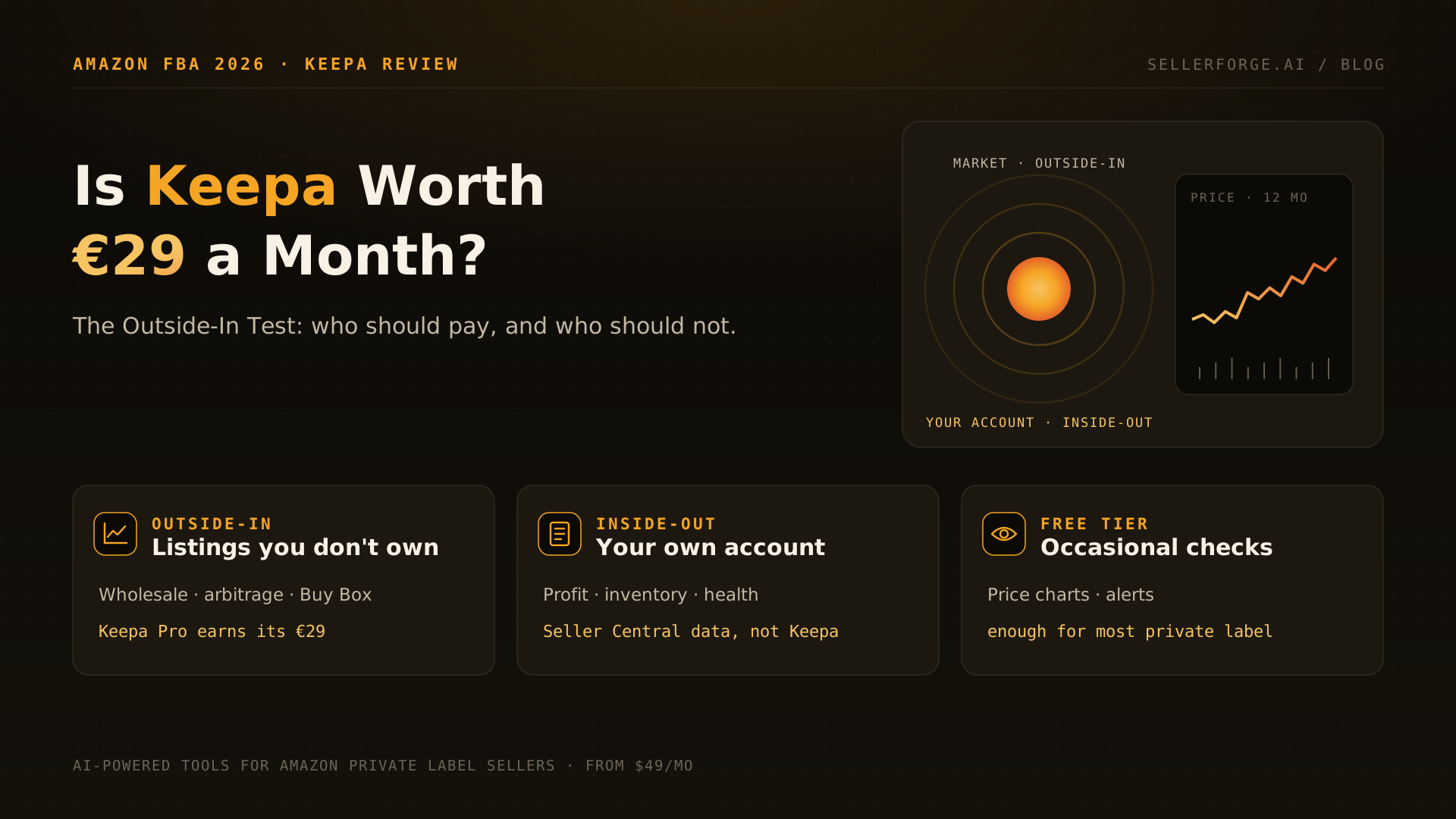
The Outside-In Test is a single question: in a typical week, do you make at least one money decision about an Amazon listing you do not control? If yes, Keepa Pro almost always pays for itself. If no, and your decisions are about your own listings, ads, and inventory, Keepa Pro is mostly a dashboard you will stop opening.
The logic is simple. Keepa's whole value is outside-in data: what happened on someone else's listing over time. Your own account's truth, including real sales, fees, returns, ad spend, and inventory age, lives inside Seller Central, and no amount of Keepa history replaces it. So the question is not whether Keepa is good. It is whether your business runs on outside-in decisions often enough to justify a monthly fee.
- Outside-in decisions (Keepa territory): Should I buy 500 units of this wholesale ASIN? Is this arbitrage price a temporary dip or a trend? How many FBA sellers share this Buy Box, and does Amazon itself jump in? Did my competitor just stock out, or cut price for a deal?
- Inside-out decisions (your account data): Which of my SKUs is unprofitable after fees and ads? When do I reorder? Why did my Account Health Rating drop? Is my TACoS rising because of ads or because organic sales fell?
The Outside-In Test: if you make at least one weekly money decision about a listing you don't own, Keepa Pro earns its €29. If nearly all your decisions are about your own listings, use the free charts and spend the budget on tools that read your own account.
In my experience the test splits cleanly by business model. Every wholesale and reseller account I worked with passed it every week. Most private-label brands passed it only during product research or when a competitor did something strange, which is a few times a quarter, and the free charts handled those moments fine.
What does the Keepa graph actually prove?
The Keepa graph proves what Amazon displayed over time: the price, the sales rank, who held the Buy Box, and how many offers existed. It does not prove how many units sold. Sales rank drops imply sales, and Keepa's monthly-sold figure mirrors Amazon's own bought-in-past-month bracket, but both are signals to read as ranges, not counts.
Read it in this order. Start with the sales rank line: frequent, regular drops mean steady sales, while long flat stretches mean the product sells rarely, whatever any estimator says. Then check the Buy Box price for stability; a jagged line means a price war you would be joining. Then check the offer count, because a listing that went from 3 to 15 FBA sellers in a month usually ends in a race to the floor. Finally, check whether Amazon itself appears as a seller, which changes the economics for everyone else.
For private label, the graph answers a narrower set of questions, and they are still valuable. Is the category leader's rank seasonal or steady? Does a competitor's price drop line up with a Lightning Deal or a stock-out? Did a new entrant's rank collapse after launch, suggesting the niche is harder than the sales estimate implies? The most valuable Keepa moment in product research is the chart that contradicts a healthy-looking revenue estimate, such as a category leader whose price has fallen 30% in a year while the estimator still shows strong revenue.
Keepa vs Helium 10, Jungle Scout, and the alternatives
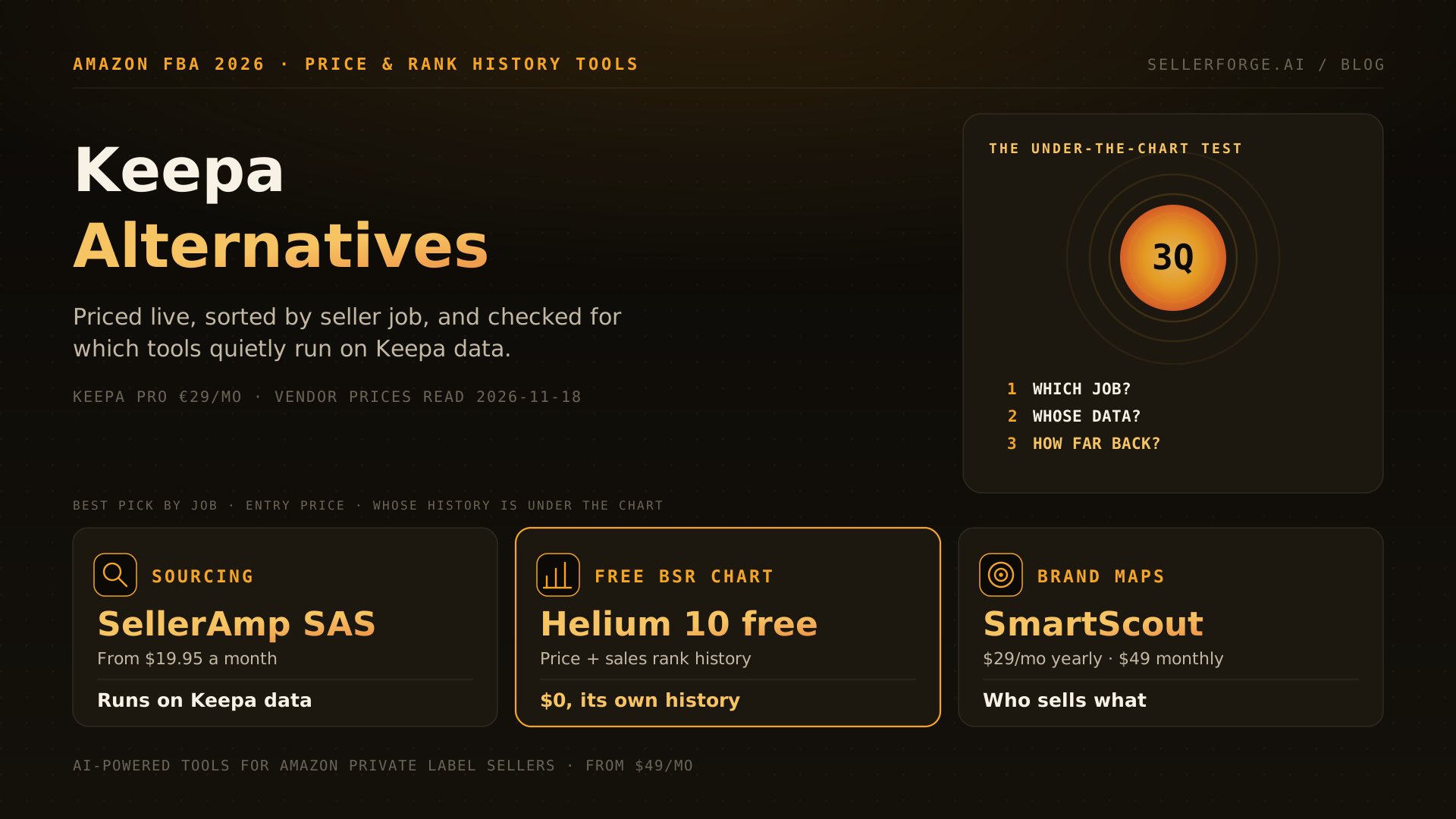
Keepa competes with research suites only at the edges. Helium 10 and Jungle Scout sell keyword research and sales estimates for private-label launches; SmartScout sells brand and seller-level market maps; SellerAmp sells a sourcing calculator for arbitrage and wholesale; CamelCamelCamel is free price history for shoppers. Keepa owns the deep historical record, and most serious sellers run it alongside one of the others.
| Tool | Price (verified) | Core job | Where it beats Keepa | Where Keepa wins |
|---|---|---|---|---|
| Keepa Pro | €29/mo (Oct 2, 2026) | Price, rank, Buy Box, and offer history on any ASIN | - | - |
| CamelCamelCamel | Free | Price history and alerts for shoppers | Free, simple | Sales rank, Buy Box, offers, bulk search |
| Helium 10 | Platinum $129/mo ($99 annual); Diamond $359/mo ($279 annual) (Oct 2, 2026) | Keyword research, listings, private-label suite | Keyword data, listing tools, ads and operations on Diamond | Granular price and offer history; cost |
| Jungle Scout Catalyst | Starter $49/mo ($29 annual) (Sep 22, 2026) | Product research and sales estimates | Beginner-friendly product research | Historical record that checks the estimates |
| SmartScout | Monthly: $49 / $119 / $299; annual-billed: $29 / $99 / $239 per month (Nov 20, 2026) | Brand and seller-level market intelligence | Market maps, brand and seller research, MCP on Business | Per-ASIN history depth at a lower price |
| SellerAmp SAS | $19.95, $29.95, $49.95/mo (Oct 2, 2026) | Arbitrage and wholesale sourcing calculator | Fees, ROI, and IP alerts in one sourcing screen | Depth of history; many sourcers run both |
| SellerForge (our product) | From $49/mo (Core) | Your own account: sales, inventory, account health, AI | Inside-out truth Keepa cannot see | Competitor price history; SellerForge shows none |
The honest pattern from the accounts I ran: wholesale and arbitrage teams ran Keepa plus SellerAmp, and Keepa was the tool they would cancel last. Private-label teams ran Helium 10 or Jungle Scout, and Keepa Pro was the subscription most likely to be paid for and ignored. Neither group was wrong. They had different jobs.
When is Keepa the wrong tool?
Keepa is the wrong tool when the question is about your own account, your keywords, or the shopper's search experience. It cannot see your fees, margins, ad performance, inventory health, or account health, and it does not do keyword research. It also matters less than it used to for shoppers, because Amazon now shows price history natively.
- You need keyword data: Keepa has none. Use Helium 10, Jungle Scout, or Amazon's own Search Query Performance and Brand Analytics.
- You need profit truth: Keepa does not know your landed cost, referral fees, FBA fees, returns, or ad spend. A Keepa chart can look perfect on a product that loses money for you.
- You only sell your own brand on single-offer listings: Buy Box history and offer counts matter little when you are the only seller, so a large share of Pro's value goes unused.
- You want shoppers' price perception: Amazon's Alexa for Shopping, which replaced Rufus in May 2026, shows shoppers price history and comparisons inside Amazon, so the shopper-side reason to read Keepa has narrowed.
- You need API data at scale: the €29 Pro plan does not include API access; the API is a separate subscription from €49 a month.
Keepa in the AI era: the API and MCP question
Keepa's API is now as interesting as its charts, because AI assistants can use market data the way an analyst would. A Starter API plan at €49 a month yields about 892,800 tokens a month, and a basic product lookup costs about one token, so a small agent can check thousands of competitor ASINs daily for less than most research suites cost.
One practical note from building these workflows: rate limits, not prices, are what bite first. Twenty tokens a minute sounds small, but tokens refill continuously around the clock and unused tokens expire after an hour, so a nightly batch job that checks a few hundred ASINs fits comfortably in the Starter plan, while a live dashboard refreshing thousands of offers does not.
Where SellerForge fits (and where it does not)
SellerForge is our product: an AI-native account intelligence platform for Amazon sellers and agencies, from $49 a month. It is not a Keepa alternative. It reads your own Seller Central data, the inside-out half of the Outside-In Test, and it shows no competitor price or Buy Box history. Sellers who pass the test should keep Keepa and add SellerForge for their own account.
Where we are not the answer: if your job is sourcing wholesale or arbitrage inventory, or tracking other sellers' prices and stock, Keepa (often paired with SellerAmp) does that and SellerForge does not. If your job is keyword research for a launch, Helium 10 or Jungle Scout wins. SellerForge is the layer that tells you what is happening inside your own business.
Who should pick what
Pay for Keepa Pro if you pass the Outside-In Test weekly. Stay on Keepa's free tier if you check competitors occasionally. Buy a research suite instead if your bottleneck is keywords and launches, and add an inside-out tool once your own account, not the market, is where the money leaks.
- Wholesale or arbitrage seller: Keepa Pro (€29/mo) is non-negotiable; pair it with SellerAmp ($19.95 to $49.95/mo) for fees and ROI.
- Private-label brand in research mode: Helium 10 or Jungle Scout for keywords and estimates, Keepa's free charts to sanity-check every estimate.
- Established private-label brand: Keepa free tier for competitor spot checks; upgrade to Pro only for the quarters you are actively fighting a competitor or entering a new niche.
- Brand with resellers on its listings: Keepa Pro to watch offer counts, Buy Box share, and unauthorized sellers over time.
- Agency managing several brands: Keepa Pro for competitive monitoring across client categories, plus a whole-account layer for the clients themselves. SellerForge's Agency plan ($499/mo for 10 accounts) is our answer for that second job; it is our product.
- Building an AI workflow: Keepa API from €49/mo for market data, plus an MCP connection to your own account data.
The bottom line: Keepa is still the best historical record of what happened on Amazon listings, and at €29 a month it is fairly priced for anyone whose decisions depend on other people's listings. It was never meant to tell you how your own business is doing. Run the Outside-In Test on your last four weeks of decisions, pay for the half of the picture you actually use, and keep the free charts for everything else.
About the author
David Gallo is the founder of SellerForge. Before building SellerForge, he managed 57 Amazon seller accounts representing over $350M in sales at Worldfront, where Keepa charts settled more sourcing arguments than any sales estimate, and where he learned which teams needed Keepa Pro and which were paying for a tab nobody opened.