Amazon Ads Agent is Amazon's AI-first ad platform, renamed on September 29, 2026, plus a conversational assistant that plans, analyzes and applies keyword, bid and budget changes after you approve them. The assistant is a closed beta reached through an Amazon Ads account executive, with no published price. It sees ad data only, so PPC software and SellerForge (ours, from $49/mo) still cover what it misses.
Amazon Ads Agent is Amazon's ad platform, renamed and rebuilt around AI on September 29, 2026, with a conversational assistant that can plan media, answer performance questions and apply keyword, bid and budget changes once you approve them. Most sellers cannot open that assistant yet, it has no published price, and it sees only your advertising data.
This guide untangles the three products that share the name, shows what access and pricing look like on November 19, 2026, and gives you a test for deciding whether Amazon's agent can run your ads alone.
What Is Amazon Ads Agent?
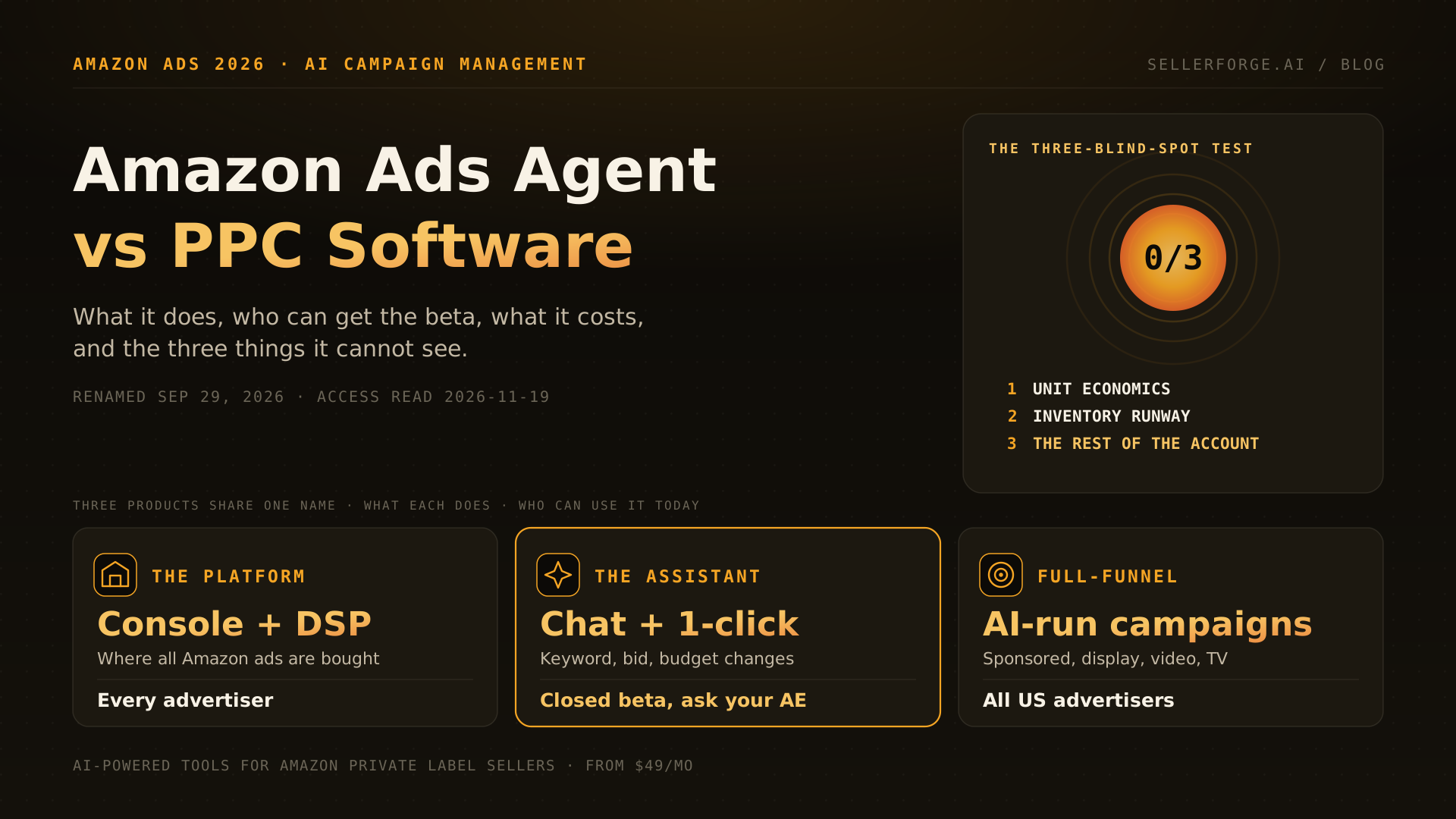
Amazon Ads Agent is three things under one name. Since September 29, 2026 it is the whole Amazon ad platform, merging the ads console and Amazon DSP. Inside it sits a conversational assistant, still in closed beta. And the name first belonged to a November 2025 agent built for Amazon Marketing Cloud and DSP buyers, which is why older coverage reads so differently.
The confusion matters because sellers read a headline about one product and assume access to another. Here is what each piece is and who can use it today:
| What carries the name | Since | What it does | Who can use it (Nov 19, 2026) |
|---|---|---|---|
| Ads Agent (original) | Nov 11, 2025 | Builds DSP campaigns from a media plan, recommends audiences, writes Amazon Marketing Cloud SQL from plain English | All AMC users; campaign features for US Multimedia Solutions DSP users |
| Amazon Ads Agent (platform) | Sep 29, 2026 | The unified console and DSP where all Amazon ads are bought | Every Amazon Ads account |
| Conversational assistant | Sep 29, 2026 (expanded) | Media planning, natural-language analytics, one-click Sponsored Products keyword, bid and budget recommendations | Closed beta in 25 countries; contact your Amazon Ads account executive |
| Full-Funnel Campaigns | Sep 29, 2026 | One campaign across sponsored ads, display, video and streaming TV, planned and optimized by Amazon's AI | All US advertisers |
| Amazon Ads MCP Server | Feb 2, 2026 | Lets Claude, ChatGPT or Gemini call the Amazon Ads API | Open beta for Amazon Ads partners with active API credentials |
| Creative Agent | Feb 2026 | Researches, storyboards and produces video and display ads | Rolling by country; Amazon says no additional cost |
Can You Use Amazon Ads Agent Yet?
You already use the Amazon Ads Agent platform if you advertise on Amazon, but the conversational assistant is a rolling closed beta. Amazon lists it in 25 countries and says to contact your Amazon Ads account executive to ask for access. Eligibility depends on marketplace, language, campaign type and capacity, and Amazon has published no criteria or end date.
The practical problem for a small private-label seller is the account executive. Many sellers spending a few thousand dollars a month have never been assigned one. If that is you, the honest answer is that you are waiting for the rollout to reach you, and nothing in Amazon's announcements says when that will be.
Plan on what you can open today. If the assistant is not in your console, it is not part of your Q1 2027 ad plan, however good the keynote demo looked.
Is Amazon Ads Agent Free?
Amazon publishes no separate fee for Ads Agent or its assistant, and in practice you pay for media, not the AI. Your ad spend still applies, and so do DSP fees and Amazon Marketing Cloud costs if you buy those. The related Creative Agent, which produces video and display ads, launched in February 2026 at no additional cost, according to Amazon.
Free is the right price to judge it against, but free is not the same as neutral. Amazon earns when advertisers spend, and its optimizer is built to improve ad outcomes such as reach, return on ad spend and new-to-brand customers. That is a real alignment with you most of the time. It is not the same goal as protecting your margin on a product with thin unit economics, which is a goal Amazon's agent has no data to pursue.
What Can Amazon Ads Agent Do for Sponsored Products?
For Sponsored Products, the assistant recommends keyword, bid and budget changes and applies them in one click after you review a summary. It also answers performance questions in plain language across nearly 1,000 metrics, diagnoses trends, benchmarks you against peers and writes Amazon Marketing Cloud queries. It does not run your own always-on bidding rules.
- Natural-language analytics: ask why ACoS rose on a campaign last week and get a written diagnosis with charts, instead of exporting three reports.
- One-click recommendations: keyword, bid and budget suggestions for Sponsored Products, shown as a change summary you approve before anything is applied.
- AI targeting: describe an audience in plain words and get suggested products, categories, keywords and Amazon audiences.
- Amazon Marketing Cloud queries written for you, which used to need SQL skills most small brands do not have.
- Billing and ad-policy questions answered inside the console, with next steps.
What Can't Amazon Ads Agent See? The Three-Blind-Spot Test
Amazon Ads Agent sees your advertising data and Amazon's ad signals. It cannot see what you paid for a product, how many days of stock you have left, or whether you lost the Buy Box this morning. The Three-Blind-Spot Test asks whether an ad optimizer sees those three things before you let it act on its own.
I coined this test after watching good bidding hurt accounts. Across the 57 accounts I managed, the costliest ad mistakes were rarely bad bids. They were reasonable bids on products that were about to stock out, sat below break-even after a fee change, or had quietly lost the Buy Box. Run every optimizer, Amazon's or a vendor's, through these three questions:
- 1Unit economics: does it know your landed cost and break-even ACoS for each product, or only the ACoS and ROAS the ad console reports?
- 2Inventory runway: does it know days of cover and inbound stock, so it stops scaling a winner that will be out of stock before the next shipment lands?
- 3The rest of the account: does it see organic rank, Buy Box ownership, suppressed listings and account health, so it does not spend into a listing that cannot convert?
Amazon's agent scores zero of three today. That is not a bug Amazon will patch next month; it is where the data lives. Your costs sit in your accounting, your inbound plan sits with your forwarder, and Buy Box and listing health live on the seller side of Amazon, not in the ad console. Every blind spot is a decision a human, or a tool that sees that data, still has to own.
The Three-Blind-Spot Test: before any ad optimizer acts alone, check that it sees (1) unit economics, (2) inventory runway and (3) the rest of the account. Each blind spot is a decision you still own.
Does Amazon Ads Agent Replace PPC Software or an Agency?
For a small account that gets beta access, Ads Agent can replace basic PPC software. For most sellers spending more than about $10,000 a month, it does not yet, because it cannot apply your own rules, guardrails per product or inventory checks continuously. Agencies still win on strategy, launches and creative judgment. Here is how the options compare on November 19, 2026:
| Option | Price (read Nov 19, 2026) | What it automates | Sees beyond ad data? | Where it wins | Honest catch |
|---|---|---|---|---|---|
| Amazon Ads Agent | No published fee; you pay for media | Recommendations applied on approval; Full-Funnel and DVA+ planning | No | Free, native, first access to new formats | Closed beta; no custom rules; ad data only |
| Perpetua | $695/mo up to $10K spend; Growth adds a % above $10K | Goal-based bidding across sponsored ads | Mostly ad data | Mature autobidding, reporting | No trial listed; % of spend at scale |
| Teikametrics | $149/mo annual or $179 monthly up to $10K; 3% of spend above $10K | AI bidding plus Walmart and TikTok Shop | Inventory signals | Multi-channel retail AI | 3% grows with your budget |
| Ad Badger | $275 to $1,830/mo flat by spend band; 30-day trial | Rule-based bidding and search-term work | No | Flat fee, transparent rules, Amazon Ads MCP included | You design the rules |
| PPC agency | Commonly 10 to 20% of spend with $1,000 to $2,500 floors (industry estimates) | People plus their tools | Whatever they ask for | Strategy, launches, creative | Most expensive; quality varies |
| SellerForge (ours) | From $49/mo; advanced ads on Growth $99 | AI account analysis, search-term buckets, guarded automations you approve | Yes: inventory, Buy Box, listing health | Ads read next to the rest of the account | Not a DSP or Full-Funnel buyer; no Walmart |
Where Amazon's agent clearly wins: anything involving DSP, streaming TV or the new Full-Funnel Campaigns. No third-party sponsored-ads tool buys those formats as natively, and if upper-funnel video is part of your 2027 plan, Ads Agent is the place to learn it.
Who Should Use Ads Agent, and Who Should Pay for More?
Use Ads Agent first if you spend under about $5,000 a month, run a simple catalog and can get beta access. Pair it with software once inventory, margin or catalog size makes approvals risky. Keep an agency only if you are buying strategy and creative, not bid changes. Match the choice to your account, not to the keynote.
- Under $5K a month in ad spend, fewer than 30 advertised products: test the assistant if you can get it; otherwise Amazon's console and its built-in recommendations are a reasonable free floor.
- $5K to $25K a month with stock-outs or thin margins: keep a tool that sees inventory and cost, and use Ads Agent's analytics as a second opinion rather than the decision-maker.
- Over $25K a month or several brands: dedicated software or an agency for execution, Ads Agent for DSP, Full-Funnel tests and Marketing Cloud questions.
- Brands testing streaming TV or video for the first time: Full-Funnel Campaigns inside Ads Agent is the simplest on-ramp, and Creative Agent can make the first assets.
- Agencies running many clients: watch the Amazon Ads MCP Server and your tools' integrations; the conversational beta is account by account.
How to Test Amazon Ads Agent Without Losing Control
Test Ads Agent on one portfolio for 30 days against a written baseline, approve its recommendations in small batches, and check stock and margin yourself before approving any budget increase. Amazon applies nothing without your approval, so the real control is how carefully you read each change summary before you click.
- 1Record a baseline before you start: total sales, TACoS, ad spend and new-to-brand orders for the last 30 days, for the whole account and for the test portfolio.
- 2Pick one portfolio of stable, well-stocked products. Keep launches, seasonal products and anything under 30 days of cover out of the test.
- 3Approve recommendations in batches small enough to read. If a summary changes 40 bids at once, approve the top ten and come back.
- 4Before approving any budget or bid increase, check days of cover and break-even ACoS for the products affected.
- 5Add negative keywords yourself. Practitioners report the assistant leaning toward broad match and loosely related terms, so review its keyword suggestions against your search-term report.
- 6Keep your own change log with the date and reason for each approved change, so you can separate the agent's effect from seasonality.
- 7After 30 days, compare the test portfolio with the baseline and with the rest of the account. Expand only if TACoS held and nothing stocked out.
Where SellerForge Fits (Disclosure: It Is Ours)
SellerForge is our product, and its advertising module is built for the three blind spots. It reads your Amazon Ads data next to inventory, Buy Box and listing-health context, writes an account-level diagnosis, and stages changes you approve. It is not a DSP, streaming TV or Full-Funnel buyer, so for those formats use Amazon Ads Agent.
What SellerForge will not do, plainly: buy DSP, streaming TV or Full-Funnel Campaigns, manage Walmart or TikTok Shop ads, or generate video creative. Amazon's own tools and Teikametrics cover those jobs better today.
About the author
David Gallo is the founder of SellerForge.ai. Before building SellerForge, he managed 57 Amazon seller accounts representing more than $350M in sales at Worldfront, where every new Amazon ad feature got the same treatment: test it on one portfolio, write down the baseline, and believe the inventory report before the dashboard.