The best Amazon brand protection software depends on the threat: Amazon's free Brand Registry, Project Zero and Transparency beat any paid tool on counterfeits, $12 to $49 monitors catch hijackers fast, MarqVision (from $99/mo) or Red Points chase fakes off Amazon, and no software removes genuine gray-market resellers. SellerForge (ours, from $49/mo) is the response layer: Plans of Action, escalations and evidence when a complaint lands on your account.
The best Amazon brand protection software is the one matched to the threat you actually have. For counterfeits on your own listings, Amazon's free Brand Registry, Project Zero and Transparency beat anything you can buy. For fast hijacker alerts, a $12 to $49 monthly monitor is enough. For copies spreading to Walmart, Temu, social media and fake websites, a takedown service such as MarqVision or Red Points earns its fee. For genuine product sold by resellers you never authorized, no software on this page removes them.
This is an unranked referee page. Every price below was read on the vendor's own pricing page on November 20, 2026, and one product on the list is ours: SellerForge, from $49 a month, which is not a monitor or a takedown service. It is the response layer for when a brand problem turns into a complaint against your own account, and I will say exactly where it fits and where it does not.
I managed 57 Amazon accounts, more than $350M in sales, at Worldfront. The most expensive brand protection mistakes I saw were not missed counterfeits. They were brands paying enterprise fees to chase sellers who were selling genuine product, and brands with real fakes who never turned on the free tools Amazon already gave them.
What is Amazon brand protection software?
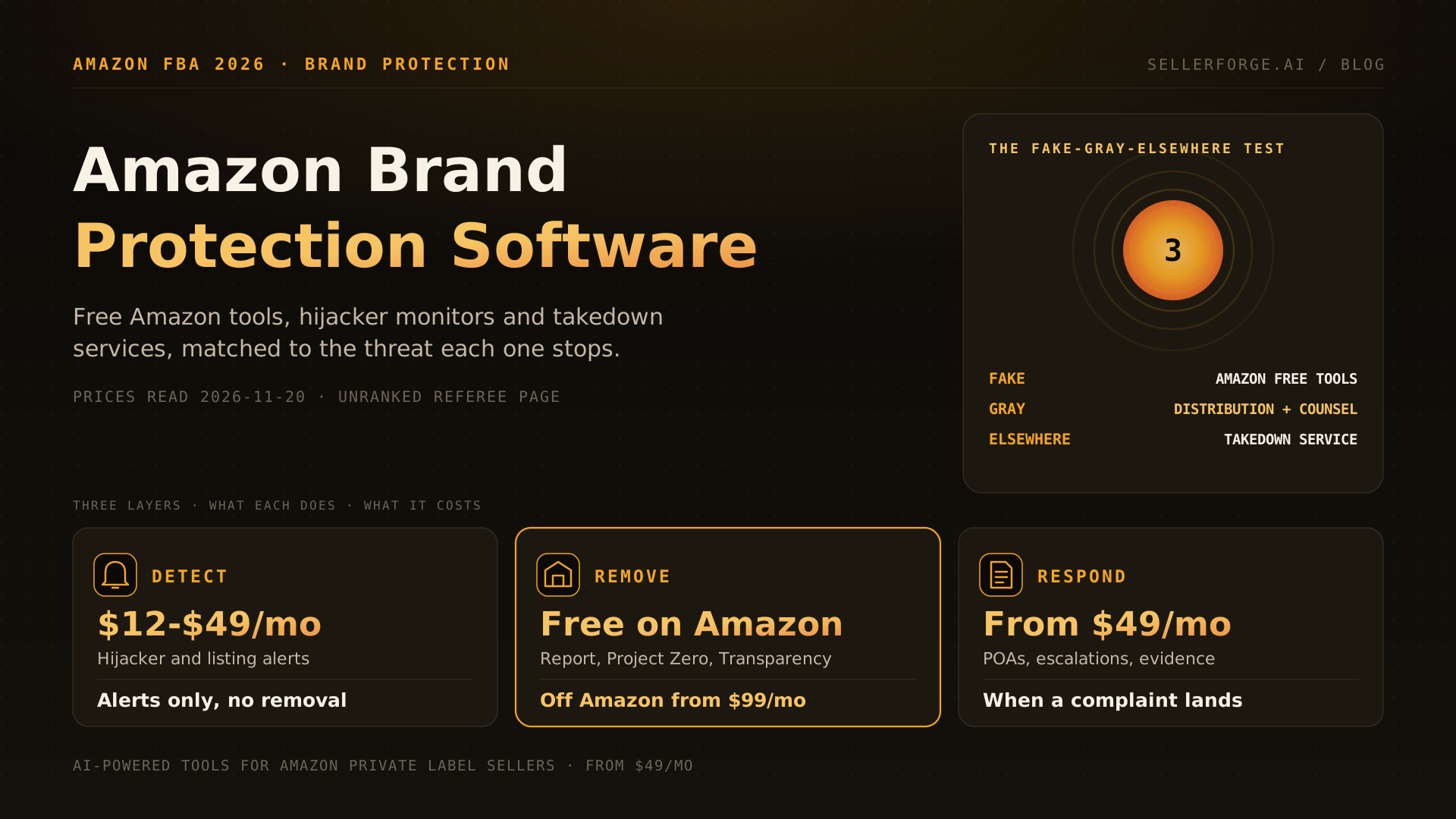
Amazon brand protection software is any tool that detects, removes or helps you answer threats to your brand on Amazon: counterfeit offers, hijacked listings, unauthorized detail page edits and copies sold elsewhere. It splits into three layers. Detection tools watch and alert, removal tools take listings down, and response tools handle the complaints and evidence that land on your own account.
- Detect: listing and offer monitors such as SentryKit, AmzMonitor, SellerSonar and Helium 10 Alerts. They tell you within hours that a new seller joined your ASIN or your title changed. They remove nothing.
- Remove: Amazon's Report a Violation, Project Zero and Transparency on Amazon itself, plus paid enforcement services such as MarqVision, Red Points, BrandShield and Corsearch that file takedowns across many platforms.
- Respond: the work that starts when the problem reaches your account, an IP or authenticity complaint, an Account Health hit, a suppressed listing. That means Plans of Action, escalations and an evidence file you can produce in minutes.
Most sellers buy in the wrong layer. A monitor cannot remove a fake, a takedown service cannot write your appeal, and neither one can remove a reseller who is selling the genuine article.
What does Amazon give brands for free in 2026?
Amazon gives brand owners four free or near-free protection tools in 2026: Brand Registry with the Report a Violation tool, Brand Catalog Lock, Project Zero's self-service counterfeit removal, and Transparency serialization at $0.01 to $0.05 per code. Together they cover counterfeits on Amazon better than any paid product, because only Amazon can block a listing before it goes live.
The scale is worth knowing. In its Trustworthy Shopping Experience Report, published in April 2026, Amazon says its proactive controls blocked more than 99.9% of suspected infringing listings before a brand owner had to find and report them. It seized and disposed of more than 15 million counterfeit products in 2025, and its Counterfeit Crimes Unit has pursued more than 32,000 bad actors through litigation and criminal referrals since 2020, with prison sentences for more than 290 people averaging 29 months.
- Brand Registry: free, requires a trademark. Report a Violation lets you search for and report infringement and track every submission. Amazon's IP Accelerator has helped more than 33,000 brands obtain trademark protection through vetted law firms.
- Brand Catalog Lock: free with Registry, off until you enable it. It locks your title, main image, bullets and description against unauthorized edits.
- Project Zero: free once eligible. You need a registered trademark, Report a Violation reports filed in the last six months with at least a 90% acceptance rate, and a clean usage history. You must keep self-service removals at least 99% accurate to keep access.
- Transparency: no enrollment fee, subscription or minimum. Codes cost $0.05 each up to 1,000,000 a year, $0.03 up to 10,000,000 and $0.01 beyond. Fully protected products cannot be listed without a valid code in 10 Amazon stores, including the US, UK, Germany and Japan. More than 90,000 brands have enrolled and 2.7 billion units have been verified.
The details and catches of each layer, including why Catalog Lock is the fastest win, are in our Brand Registry hijacker defense guide. Project Zero eligibility and the 99% rule are on Amazon's Project Zero page, and the code price tiers are on Amazon's Transparency page.
Read the 99.9% figure from both sides. It means the counterfeits that still reach your listing are the ones that beat Amazon's filters, so they are exactly the ones you have to find yourself. It also means Amazon's filters act on honest sellers too, which is why your own evidence file matters.
The Fake-Gray-Elsewhere Test: which threat are you fighting?
The Fake-Gray-Elsewhere Test sorts every unwanted offer into one of three threats before you spend a dollar: Fake (counterfeit or infringing), Gray (genuine product from a seller you did not authorize) or Elsewhere (your brand copied off Amazon). Each threat has a different winner, and buying the wrong tool for it is the most common waste in this category.
- 1Pull every new offer and every unauthorized content change on your ASINs from the last 90 days. A monitor's alert history or Amazon's own offer listings will do.
- 2Test-buy one unit from each unfamiliar seller. Compare packaging, lot codes, labels and the product itself against your own stock, and photograph both side by side.
- 3Label each seller FAKE if the unit is counterfeit, mislabeled or infringes your trademark, GRAY if it is genuine and unaltered but came through a leak in your distribution, and ELSEWHERE if the copy lives on another marketplace, social platform or website.
- 4Route FAKE to Amazon: Report a Violation now, Project Zero once eligible, Transparency if the same fake keeps returning.
- 5Route GRAY to distribution control: find the leak, tighten reseller agreements, use authorization letters and Amazon's approval requirements, and bring in counsel if a reseller is selling materially different goods.
- 6Route ELSEWHERE to a paid takedown service, and only buy one when that pile is real and growing.
| Threat | What it looks like | Who wins | Typical cost |
|---|---|---|---|
| Fake | Counterfeit or infringing units on your ASIN or a copycat listing using your mark | Amazon: Report a Violation, Project Zero, Transparency | Free; Transparency $0.01 to $0.05 per code |
| Gray | Genuine units from a distributor leak, liquidator or retail arbitrage | Distribution control, LOAs and legal counsel; no software removes them | Your time, or attorney fees |
| Elsewhere | Your brand or images on Walmart, Temu, TikTok Shop, social ads or fake sites | Takedown services such as MarqVision or Red Points | From $99/mo annual (MarqVision Base) to custom quotes |
| Any of the three, detected late | You learn from a buyer review or a lost Buy Box days later | A listing and offer monitor | $12 to $49/mo |
In the accounts I ran, the gray pile was usually the biggest one, and it was the pile brands most wanted software to fix. Being honest about that saves money, because it moves the spend from tools to distribution cleanup where it belongs.
Best Amazon brand protection software in 2026, compared
The best Amazon brand protection software in 2026, compared by job: Amazon's free tools win on-Amazon removal, SentryKit, AmzMonitor and SellerSonar win cheap detection, MarqVision is the clearest self-serve takedown service and Red Points the broadest custom one. Every price was read on the vendor's own page on November 20, 2026, and SellerForge is ours.
| Tool | Layer | Price (read Nov 20, 2026) | Where it wins | Honest limit |
|---|---|---|---|---|
| Brand Registry + Report a Violation | Remove (on Amazon) | Free; needs a trademark | Official reporting authority and submission tracking | Reactive by default; will not remove genuine resellers |
| Project Zero | Remove (on Amazon) | Free once eligible | Instant self-service counterfeit removal | Invite-based; lose access below 99% accuracy |
| Transparency | Prevent (on Amazon) | $0.05 to $0.01 per code by volume; no fees | Blocks listings and shipments without valid codes | Labels on every unit; genuine gray units carry valid codes |
| SentryKit | Detect | $19/mo (2 storefronts) or $15 annual; Pro $49 (5); Teams $99 annual | Real-time hijacker, Buy Box and suppression alerts, unlimited ASINs | Alerts only, no takedowns |
| AmzMonitor | Detect | $12 to $200/mo for 20 to 1,200 ASINs at 24-hour checks | Cheapest entry for small catalogs | Faster checks cut the ASIN count |
| SellerSonar | Detect | $19.98 to $74.98/mo billed annually (150 to 500 ASINs) | Content-change and hijacker alerts | Checks every few hours, not real time |
| Helium 10 Alerts | Detect | Inside paid plans; Platinum $129/mo or $99/mo annual | Useful if you already pay for Helium 10 | Per-plan alert limits are not clearly published |
| Threecolts Seller 365 | Detect (bundle) | From $69/mo (Reseller); Brands from $179/mo | Alerts bundled with repricing and review tools | The standalone Bindwise alerts plan now redirects to this bundle |
| MarqVision | Remove (multi-platform) | Base $119/mo or $99 annual; Core $600; Pro $1,200; Max $2,400 | Published self-serve tiers with a 14-day trial | Base caps takedowns at 30 a month; gray-market work is Enterprise only |
| Red Points | Remove (multi-platform) | Custom quote | Unlimited detections and takedowns on custom plans; gray-market plans available | Self-serve configurator prices do not reconcile; get a written quote |
| BrandShield / Corsearch | Remove (enterprise) | Quote only | Domains, phishing and impersonation across channels | Built for large companies; Amazon is a small slice |
| SellerForge (ours) | Respond | From $49/mo; POA and Escalation on Core | POA drafts for IP and authenticity complaints, escalation plans, evidence vault | Not a monitor and files no takedowns |
Two notes on the paid rows. MarqVision is the only takedown service that publishes every tier, and its pricing page shows lawyers and gray-market enforcement reserved for Enterprise, which matches the point of the test above. Red Points has a self-serve page that lists Amazon coverage at $285 a month, but its line items and minimum payment do not add up to one clear total, so treat any Red Points number as provisional until you have a written quote.
AMZAlert, a monitor that still appears on many older lists, shows only a launching-soon page on its own domain, so confirm any monitor is accepting signups before you plan around it.
Can brand protection software remove unauthorized resellers?
No. Brand protection software cannot remove a reseller who sells genuine, unaltered product, because that is not infringement. Under the first-sale doctrine, a lawful buyer of genuine goods can generally resell them, and Amazon has long said it does not enforce private distribution agreements. Removing gray-market sellers is a distribution and legal job.
What changed in 2026 is the friction around reselling. Amazon ended FBA commingling for new inventory on March 31, 2026, and since that date only sellers with the Brand Representative role keep using manufacturer barcodes for FBA units. On April 30, 2026, a Seller Central post laid out approval requirements, Letters of Authorization and invoices from manufacturers or authorized distributors dated within 180 days, and PPC Land's May 2026 analysis documented the pushback from resellers and attorneys who argue it edges into enforcing distribution. For a brand, that means approval gates now help, but the legal line is contested, so do not build your plan on Amazon removing genuine sellers for you.
- Find the leak first. Gray units almost always trace to one distributor, a wholesale account or a liquidation lot. Serial or lot codes on your units make the trace possible.
- Put authorized-reseller terms in writing, with consequences, before you ask anyone to stop.
- Use material differences carefully. Goods sold without your warranty, with altered packaging, or meant for another market can lose first-sale protection, but that call belongs to an attorney, not a template.
- Expect law-firm programs such as Vorys eControl to quote custom fees. They are legal services, not software.
- Never report a genuine reseller as counterfeit. An inaccurate report is the fastest way to lose Project Zero, and it can become an abuse claim against your own account.
Is paid brand protection worth it for a private-label brand?
Paid brand protection is worth it for a private-label brand only when the Elsewhere pile is real: your products, images or trademark show up on other marketplaces, social ads or lookalike websites faster than you can report them by hand. If every infringing listing you find is on Amazon, the free tools plus a $12 to $49 monitor cover the job.
Run the math with published numbers. MarqVision's Base plan is $1,188 a year billed annually for 30 takedowns a month on three platforms, about $3.30 per takedown if you use them all. If you file five a month, it is roughly $20 each, and Project Zero does the Amazon share for nothing. The fee pays when the volume is high and off-Amazon, and it is waste when it is low and on-Amazon.
| Your situation | What to buy | Monthly cost |
|---|---|---|
| Under ~$1M a year, Amazon only, occasional hijacker | Brand Registry, Catalog Lock, one monitor | $0 to $49 |
| Repeat counterfeits of the same ASIN | Add Transparency; apply for Project Zero | $0.01 to $0.05 per unit |
| Copies on 3+ other platforms or social ads | Add MarqVision or a Red Points quote | From $99 billed annually |
| Mostly genuine unauthorized resellers | Distribution cleanup and counsel, not software | Legal fees, case by case |
| Complaints or Account Health hits from any of the above | A response layer with POA drafts and an evidence vault | From $49 |
Where SellerForge fits (and where it does not)
SellerForge fits the response layer: when a brand problem turns into an IP complaint, an authenticity violation or an Account Health hit on your own account, it drafts the Plan of Action, sequences the escalation and keeps the evidence ready. It does not monitor offers in real time and it files no takedowns, so pair it with Amazon's free tools and a monitor.
Full disclosure: SellerForge is our product. Here is what the live features page supports today. The POA Builder drafts all three sections of a Plan of Action in Amazon's format, and Escalation Plans generates a step-by-step ladder with ready-to-send messages across 12 issue types, IP complaints included. Both are on Core at $49 a month. The Document Vault stores trademark certificates, supplier invoices, authorization letters and test-buy photos, 1 GB on Core and 10 GB on Growth at $99, and links straight into a POA package.
The Business Event Timeline keeps a dated record of listing, price and account events, which is what you want when you need to show Amazon when a hijack started. The Listing Audit scores your detail page across 10 dimensions, useful after a hijacker has edited content. Account-health metric alerts in the Alerts Center are in limited availability and in-app only for now, so do not treat SellerForge as your hijacker alarm. Agencies running brand defense for clients can use the $499 Agency plan across client accounts.
Where we lose, plainly: SentryKit at $19 a month is a better alarm, Project Zero is a better takedown button and costs nothing, and MarqVision or Red Points cover platforms we never touch. We are also not a law firm, so a gray-market fight or an IP case headed to court belongs with counsel, with our output as the organized starting point.
If a complaint has already landed, start with our Plan of Action guide for IP complaints, and if the issue is a condition complaint rather than a fake, the used-sold-as-new complaint playbook covers it. The wider account view is in our account health software comparison.
Who should pick what in 2026
Pick by threat, not by brand name. Every seller with a trademark should run Amazon's free stack first, most should add one inexpensive monitor, and only brands with a real off-Amazon copy problem should pay for a takedown service. Genuine resellers need distribution work, and complaints against your own account need a response layer.
- New brand, trademark pending: apply to Brand Registry as soon as you can, use IP Accelerator if you need speed, and turn on Catalog Lock the day you are in.
- Established private-label brand with occasional hijackers: SentryKit, AmzMonitor or SellerSonar for alerts, Report a Violation for fakes, and a test buy before every report.
- Brand with recurring counterfeits on Amazon: Transparency on the targeted ASINs and Project Zero once invited.
- Brand copied across Walmart, Temu, social and websites: start a MarqVision trial or get a written Red Points quote, and compare cost per takedown.
- Brand fighting genuine unauthorized resellers: distribution cleanup and counsel, not another tool.
- Any brand that has received an IP or authenticity complaint: SellerForge from $49 a month for the POA, escalation and evidence work.
For the rest of your stack by category, see the best Amazon seller tools in 2026, and for the score that a confirmed counterfeit complaint can wipe out, our Account Health Rating defense guide.
Want the response layer ready before the next complaint? Start a free SellerForge trial: POA Builder, Escalation Plans and the Document Vault from $49 a month, with a 7-day free trial and no credit card.
About the author
David Gallo is the founder of SellerForge.ai. Before building SellerForge, he managed 57 Amazon seller accounts representing more than $350M in sales at Worldfront, where brand defense meant one rule above all: diagnose the threat before you pay anyone to fight it.